Most digital marketing agencies die at 12 clients. One founder, one account manager, enough work to miss a cold email, not enough margin to hire. The question of how to get clients for a digital marketing agency changes shape at that point: the thing that worked at four clients, usually a referral or a freelance platform, stops producing enough to replace the ones that churn.
Nothing fixes that except having a prospecting process that runs when the week is busy. Not a sprint when the pipeline looks thin. A system that reaches twenty or thirty of the right businesses every working day, with a specific reason to reply, so that one or two new conversations open on their own.
This guide covers who to target, how to find the leads, what to say in the first email, how to turn a reply into a signed project and what to charge once the client is on board. It's written for agencies that offer web design, SEO, paid ads or a mix, which is most of them. Nothing here needs paid ads, a referral network or an existing audience.
Pick a niche the market already asks for
A generalist agency competes on price with every other generalist and wins on nothing. A specialist agency gets referred by name because the market has a shape for it. The clients are the same size, the work is the same shape, and the first conversation starts from a position of knowing the business.
The best niches aren't the ones with the biggest market, they're the ones where one new customer is worth enough that marketing feels cheap. A roofing company whose average job is $9,000 can pay a $1,500 a month retainer without thinking. A café selling $5 coffees usually can't.
Who to pick when picking a niche
Look at the last ten clients the agency signed. Group them by what the business sells, not by what the agency built for them. If three or four fall into the same category, that's the niche the market is already handing the agency, and a cold email to a similar business will close faster than one to a stranger.
If there's no pattern yet, pick a vertical with high ticket size and clear local search intent. Roofers, HVAC companies, med spas, dental practices, personal injury lawyers, home remodelers and family law firms all share that shape. Pick one, work it for ninety days, then decide whether to add a second.
Why one city at a time beats a whole state
Working one niche in one city teaches the agency the common website problems, the rough prices customers pay, and the names of the two or three competitors who already dominate. By lead 50 the pitch gets much sharper, because every claim in it is grounded in sites the writer has looked at. Patterns in a specific trade repeat, so the twentieth roofer site teaches less than the second one did.
A list of 200 roofers in Phoenix is also small enough to write a specific email to each business in a week. A list of 2,000 "small businesses in Arizona" is too mixed to learn from and too big to work by hand. Once the first city is working, repeat the method in the next one rather than widening the first one.
See what's wrong with any website in seconds
The free analysis checks speed, mobile and SEO, then shows what to say to the owner. No signup, no card.
Build the lead list for yourself
Bought lists are the shortest path to a dead campaign. Half the addresses bounce, a quarter of the businesses have closed, and the rest go to generic inboxes nobody reads. Three days building a fresh list beats three months rotating paid lists that go nowhere.
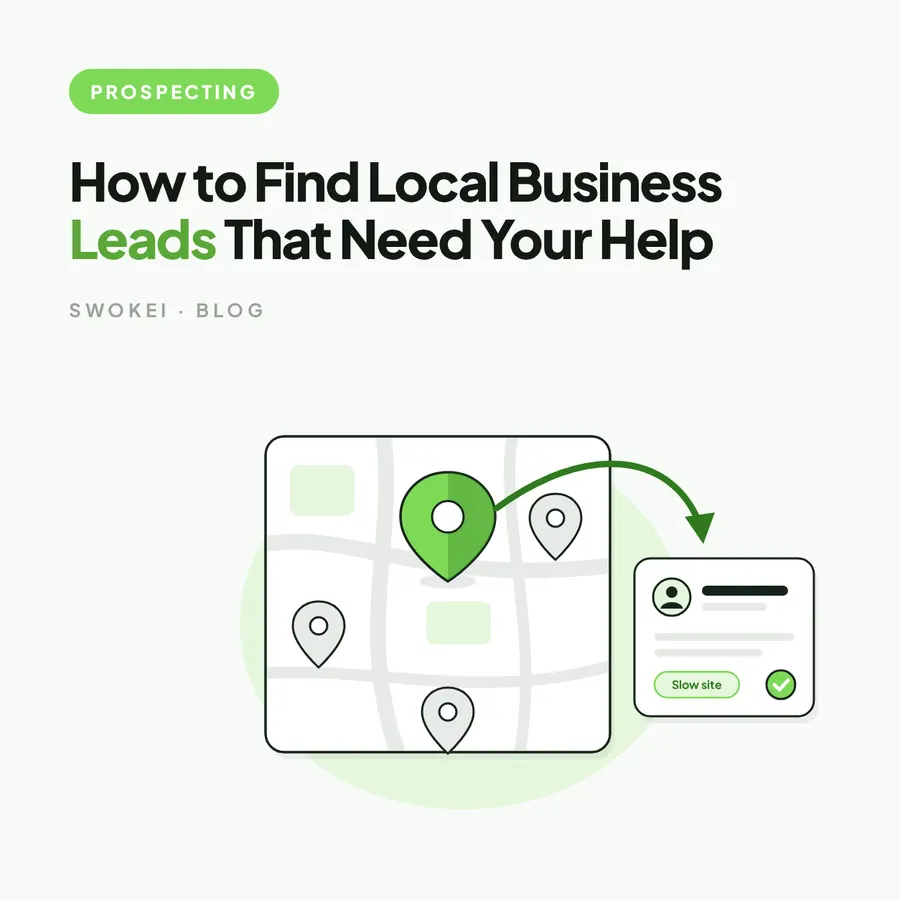
The best free source is Google Maps. Every listing is tied to a real location, most link to a website, and the reviews show how busy the business is. A single search of a service in a city returns up to 120 businesses, and owners keep those listings current because that's where customers find them. There's a full breakdown of this in the guide on finding local business leads.
What to record from each listing
Pull the business name, website, phone number, star rating, review count and city into a spreadsheet. Add the category to make filtering easy later. Those seven columns are enough to qualify every lead without opening the listing a second time.
The review count is the most useful column on the list. A business with 20 to 200 reviews is established enough to afford marketing and small enough to still feel the pressure of local competition. Under 10 reviews is often too new or too small, and over 500 reviews usually means an agency is already involved.
Fill the gaps from other sources
Yelp covers restaurants, salons and home services well, and Angi covers contractors. Industry directories work for licensed trades: state bar listings for lawyers, dental boards for dentists, contractor licence lookups for builders. New business filings and building permits are a strong source too, because a company registered last month almost certainly needs a website.
Deduplicate by domain and phone number before writing to anyone. The same business often appears in four directories under slightly different names, and sending to all four looks like spam to the business and to its mail provider. A sorted spreadsheet catches most of the duplicates in a minute.
Qualify leads by their website, not by instinct
A list of names isn't a list of leads yet. For an agency offering web design, SEO or paid ads, the website decides whether a business is worth an email. A fast, well structured site with no problems is a business that doesn't need help. A slow, broken or outdated one is a client waiting to be shown the gap.
Qualifying also gives the agency the reason to write. An email that opens with a real problem on the owner's own site gets read. An email that opens with the agency's services gets deleted in two seconds.
What makes a lead pitchable
The best signals are the ones an owner can verify in a minute on their own phone. A homepage that takes six seconds to load, a site that breaks on mobile, a missing or duplicate page title, or a contact form that doesn't submit are all easy to check. So is a copyright year from 2019 in the footer, which tells the owner nobody has touched the site in years.
Combine website signals with business signals. A dental practice with 180 reviews and a slow dated site is a far better lead than one with 6 reviews and the same problems, because it has the revenue to act. Any site run through the free website analysis comes back with real SEO, speed and mobile findings in a few seconds, with no signup.
Checks that scale past 20 leads
Checking every site by hand takes about 15 minutes each, which breaks down past about ten. For a list of 200 businesses an agency needs a tool that runs the same checks in bulk and keeps the findings next to each lead. The cold email software roundup covers the tools that pair that research step with sending, and the Instantly alternative comparison breaks down the ones that focus on sending rather than research.
Drop leads that pass every check. It feels wasteful to throw away a third of the list, but writing to businesses with nothing to fix burns sending reputation for no return. Keep those sites in a separate tab, because one that looks fine today may need help in a year.
Weighing up tools?
Honest comparisons with the tools agencies already use, including where they beat Swokei.
Write cold emails worth opening
The agency's email has one job: get the owner to agree the problem is real and worth a short call. It isn't the place to list services, explain how the agency works or attach a thirty page audit. Five or six sentences on a phone, between jobs, is the whole budget.
Lead with the finding, stated plainly and tied to the owner's business. Then say what it costs them in words they already use, usually missed calls or a competitor showing up higher. End with a small ask, like whether they want the other two issues the agency spotted sent over, rather than a demand for thirty minutes next Tuesday.
Personalisation that owners actually notice
Merge fields like first name and company stopped feeling personal a decade ago. The thing an owner replies to is the exact page named, the exact load time measured, the exact competitor who outranks them. That level of specificity proves a human looked, or at least that the message came from the site itself.
Agencies that try to bridge the gap with longer templates and more merge fields rarely improve the result. Length doesn't make an email specific. Reading the site before writing does, and the split between generic and personalised outreach shows why.
Follow ups that add something new
Most agency replies come from the second or third touch, not the first. The common mistake is sending a follow up that just asks whether they saw the last email. That adds nothing and reads as pressure.
A better follow up brings a second finding. If the first email covered the slow mobile homepage, the next can mention that the contact page has no city name in its title, so it never shows up for local searches. Two follow ups spaced three and seven days after the first is enough. More than that burns goodwill without lifting replies.
Close the first conversations and set the price
A reply isn't a client. The call is where the sale happens, and most agencies lose it by sending a quote by email afterwards instead of showing something live. Owners buy when they see the gap on their own screen, not in a PDF opened later.
On the call, open the site together and walk through the findings. Show the competitor who ranks first and point out two or three things their site does that the prospect's doesn't. Most owners close themselves at that point, because the gap is now visible rather than theoretical.
Price small enough to say yes
Big monthly retainers scare owners who've been burned by an agency before, and many of them have. A fixed project to fix the specific things found in the audit, in the range of $750 to $1,500, is far easier to approve. When the project finishes and calls pick up, a monthly retainer becomes a natural next conversation.
Track one number the owner cares about from day one, usually calls from the website or form fills a month. Ranking reports mean little to a roofer. Going from eleven leads a month to nineteen means a lot, and that one number is what turns a one off into a client who stays for two years.
Build a repeatable sales process
The first ten clients teach the agency what makes a close easy and what makes it slow. Write down the stages: lead to reply, reply to call, call to project, project to retainer. Measure how many move from one to the next, and the weakest step gets the attention first.
Keep prospecting running while the first projects are underway. A steady 30 to 50 personalised emails a day, each built on a real finding, usually produces a handful of calls a week once the niche is dialled in. Stopping prospecting the moment a deal closes is how agencies end up in a feast and famine cycle.
The fastest way to test all of this is on one real business tonight. Pick a local company in the chosen niche, run its homepage through the free website analysis, and write the email around the single finding that costs it the most customers. Send it before the next pitch and the agency will know within a week whether the angle works for that niche.
Run it on a real site before your next pitch
Analyse a prospect's site for free, or start free and let Swokei write the email from what it finds.