An agency owner signs up for three tools in a month, sends 2,000 emails through each, and ends up with the same six replies every time. The tool was never the problem. Picking the best cold email software starts with knowing which part of outreach is failing, because the market splits into tools that send more, tools that find more and tools that write better.
Most lists of cold email tools rank them on feature counts. That's how agencies end up paying for LinkedIn steps nobody uses and a contact database full of job titles they never target. A web design or SEO agency selling to local businesses needs a much shorter list of things, and it needs them done well.
This guide groups the main options by what they're actually good at, says who each one suits, and names the catch with each. Prices change often, so the comparisons below describe each tool's pricing in shape, and you should check the vendor's own page on the day you buy. Swokei is one of the tools covered, and its limits are named as plainly as everyone else's.
What separates good cold email software from the rest
Every serious tool now sends from multiple mailboxes, runs follow-ups and warms new inboxes. Those are table stakes in 2026, and a tool missing any of them isn't worth a trial. Newsletter platforms fail this test outright, which is why agencies moving off them look for software built for cold email instead of newsletters. The differences that matter sit elsewhere.
The first is how pricing scales with your agency. Some tools charge per user, some per mailbox, some per contact and some per email sent. A plan that looks cheap for one founder can triple when a second salesperson joins, so price the setup you'll have in six months.
The second is where the leads come from. A built-in database is handy if you sell to job titles at funded companies, and nearly useless if you sell to the owner of a roofing firm. Agencies pitching website work usually need leads by place and category, not by seniority.
The third, and the one most lists skip, is what the email is written from. Merge fields like first name and company don't count as personalisation anymore, because every owner has seen them a thousand times. The software that earns replies is the one that gives each email a real reason to exist.
Deliverability comes before every other feature
None of the above matters if the emails land in spam. Look for warmup that runs continuously, sending limits you can set per mailbox and a spread of sends across the day rather than bursts. A healthy setup keeps each mailbox to roughly 30 to 50 cold emails a day.
Check how the tool handles bounces and unsubscribes too. A bounce rate above 2 percent will damage a domain within weeks, so built-in verification or a clean import from a verified list is worth paying for. Tools that let you pause a mailbox automatically when bounces spike save a lot of grief.
See what's wrong with any website in seconds
The free analysis checks speed, mobile and SEO, then shows what to say to the owner. No signup, no card.
Volume senders for teams that write their own emails
The first group is built to send a lot of email cheaply and reliably. These tools assume you already have a list and already know what to say. If that describes your agency, they're the most cost-effective choice on this list.
Their weakness is the mirror of their strength. They make sending easy, so they make it just as easy to send the same weak email to thousands of people. An agency with a bad opening line will burn through domains faster on these tools than anywhere else.
Instantly
Instantly is the best-known volume sender, with unlimited email accounts on its sending plans and a large shared warmup network. Campaign setup is quick, and the unified inbox makes handling replies across dozens of mailboxes manageable. It also sells a lead database as a separate product, which keeps the core sender simple.
It suits agencies running high volume to broad lists, and it suits teams with a copywriter who keeps the messaging sharp. The catch is that personalisation beyond merge fields is up to you. Agencies that want the research done for them tend to outgrow it.
Smartlead
Smartlead is similar in shape, with unlimited mailboxes, automatic mailbox rotation and strong controls over sending windows. Its standout for agencies is client workspaces, which let a lead generation agency run campaigns for several clients from one account. White-label options make it popular with agencies that resell outreach as a service.
The trade-off is a busier interface and a steeper setup than Instantly. It's a tool for operators who enjoy tuning settings. Like Instantly, it sends whatever you give it, so the quality of each email is still your job.
All-in-one platforms with data and extra channels
The second group bundles sending with a contact database, and often with calls, LinkedIn steps or messaging apps. These platforms suit sales teams that run structured cadences across several channels. They cost more, and they make most sense when every channel in the bundle gets used.
Reply.io sits at the far end of this group, with email, LinkedIn, calls and SMS in one sequence and an AI SDR on top. For a web agency selling to small businesses, much of that breadth goes unused. Many local owners have no active LinkedIn profile at all, and phone steps need someone dialing.
Saleshandy
Saleshandy pairs a capable sender with a large B2B contact database and a lead finder that charges credits per verified email. It also adds call and WhatsApp steps for teams that want them. The pricing caps active prospects and monthly emails by plan, which is worth mapping against your list size.
It suits agencies that sell to companies by job title and want data and sending in one bill. It suits local business prospecting less well, since the database is built around roles rather than places. The details are in this breakdown of where Saleshandy stops fitting web agencies.
Woodpecker
Woodpecker has been around longer than most and still has some of the best deliverability safeguards in the market. It checks for bounces, catches risky sending patterns early and supports condition-based sequences that branch on opens and replies. An agency panel lets one team manage several client accounts.
It's a careful, steady choice for agencies that value inbox placement over speed. The interface feels older than newer rivals, and the personalisation is still template-driven. This comparison of the options agencies pick over Woodpecker covers when that matters.
Weighing up tools?
Honest comparisons with the tools agencies already use, including where they beat Swokei.
Software that writes from the prospect's own website
The third group is newer and much smaller. Instead of sending your template faster, these tools research each lead and write the email from what they find. For agencies selling web design, SEO or speed work, the prospect's website is the best research source there is.
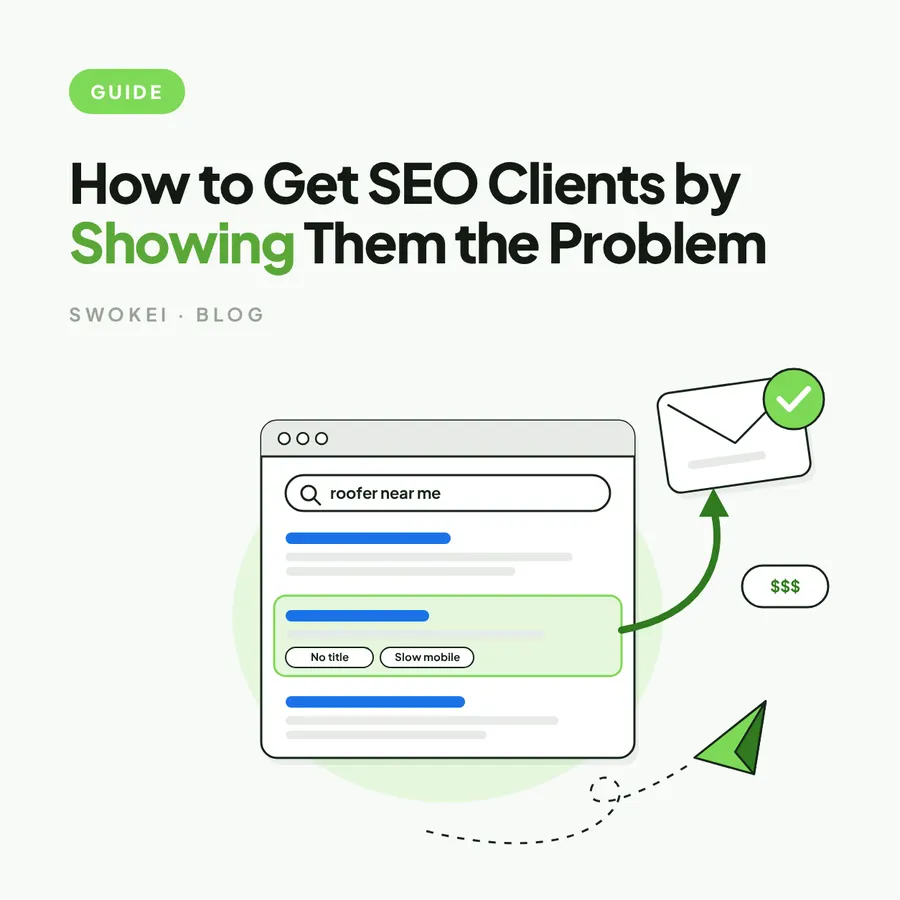
A slow mobile homepage, a missing title tag or a contact form that breaks on a phone is something the owner can check in under a minute. An email built on that kind of finding reads as attention rather than automation. You can see the kind of findings involved by running any lead through the free website analysis, which returns real speed, SEO and mobile issues with no signup.
Swokei
Swokei finds local businesses by place and category, reads each site and writes an email around the issue most likely to cost the owner customers. Picture a family dentist whose booking page takes 6.1 seconds to load on a phone. The email opens on that page and asks one small question about it, rather than pitching a redesign.
Plans are priced per team, not per user. Basic costs $49 a month with 2,000 credits, Pro $99 with 5,000 and Agency $249 with 13,000, and every paid plan sends unlimited emails from unlimited mailboxes. A credit covers one lead whose site gets read and whose email gets written, and there's a free plan with 20 credits to test it.
The limits are real. Swokei is email only, with no LinkedIn, call or SMS steps, and it has no people database for finding a marketing director at a large company. Agencies selling to enterprise buyers by job title are better served by the platforms above.
The cost per message is also higher than a pure volume sender, because each credit pays for research. That pays off when the email actually uses the finding. If your agency sends thousands of lightly personalised emails a week, a volume sender is the cheaper fit.
Which cold email software fits which agency
There's no single winner, and any list that crowns one is selling something. The right pick depends on who you sell to, how many people prospect, and if your real problem is volume or replies. Two common situations cover most agencies.
Before switching anything, look at the last month of results. If emails are opened and ignored, the message is the problem and a faster sender won't fix it. If replies are fine but volume is low, a better sender is exactly the right move.
Solo founders and two-person studios
A founder doing outreach between client projects needs the research done for them, because that's the step that gets skipped when work is busy. Per-user pricing hurts least here, but time hurts most. A tool that turns 40 leads into 40 specific emails in the time it takes to write two by hand is the one that keeps prospecting alive.
Keep the setup small: two or three mailboxes on a separate domain, one niche, one city. A positive reply rate of 3 to 5 percent from local owners is a strong result for website work. The habits in this guide to raising cold email reply rates apply whichever tool you choose.
Growing agencies with a sales hire
Once someone's job is outreach, volume and process start to matter. Many agencies at this stage run two tools: one that researches and writes for the highest-value leads, and a volume sender for broader lists. That split works as long as nobody pays per seat twice for the same people.
Agencies that close through calls and LinkedIn as much as email should look hard at the multichannel platforms. Agencies that close mostly through email replies from small business owners will get more from better research than from more channels. Adding a channel nobody works just adds a bill.
The quickest way to test any of this is on one real lead today. Run a prospect's homepage through the free website analysis and compare the findings with the opening line your current tool would send. If the findings make the better email, you know which kind of cold email software your agency is missing.
Run it on a real site before your next pitch
Analyse a prospect's site for free, or start free and let Swokei write the email from what it finds.