This Swokei review exists because most product pages answer the wrong question. They explain how the tool works and leave the harder question — whether it is worth the time for your specific agency workflow — entirely alone. The short version: Swokei is a website analysis and cold-email generation tool built for web design and digital agencies doing outbound prospecting. It is not a CRM, not a full sales automation suite, and not a general-purpose SEO auditor. If those last three things are what someone needs, it is the wrong product. If the specific problem is turning a prospect's broken website into a personalized first-touch email without spending 25 minutes per lead on manual research, it is worth a closer look.
On pricing: Swokei operates on a credit-based model where each website analysis consumes credits, and plans are structured around the volume of prospects an agency wants to analyse per month. There is no free trial that requires a card, and the entry point is low enough that a single closed deal from one campaign typically covers the annual cost several times over. The exact current tier prices live on the pricing page itself, and they do change with the product, so this review will not invent a number that may already be wrong. What is accurate as of writing: there is no enterprise contract, no per-seat fee stacked on top of the base cost, and the analyser at swokei.com/website-analysis runs without any account at all, which is the fastest way to see what the output actually looks like before spending anything.
What the product actually does, in one concrete example
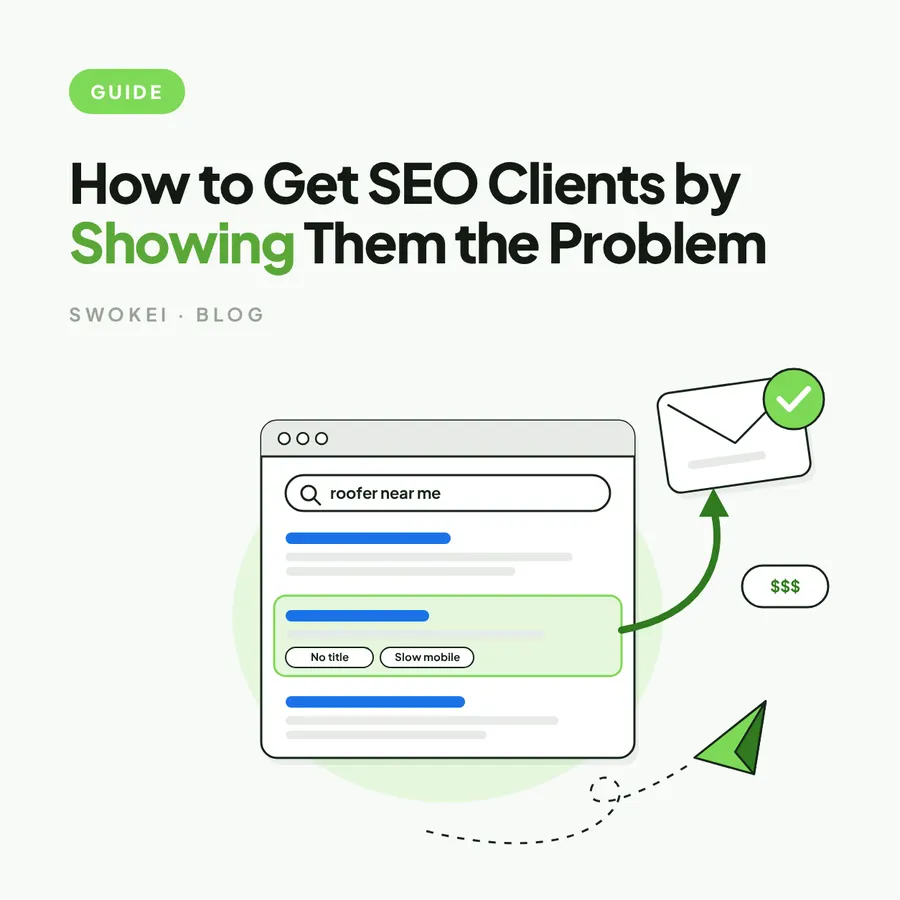
An agency founder pastes a prospect's URL — say, a regional accountancy firm whose website was last redesigned in 2019 — and Swokei runs a scan across four dimensions: design quality, SEO fundamentals, page speed, and mobile rendering. It does not require any API key, any browser extension, or any manual configuration. The scan returns real findings: in a test on a mid-sized professional services site, the tool surfaced a Largest Contentful Paint of 6.8 seconds on mobile, 14 missing meta descriptions across key service pages, and a layout that broke below 480px viewport width. Those are not categories of problems. They are the specific problems, with the specific numbers, for that specific prospect.
What happens next is the part that either makes sense for an agency's workflow or it does not. Swokei takes those findings and drafts a cold outreach email that references them directly. Not "your site may have some speed issues" but a sentence naming the 6.8-second load time and connecting it to what that means for the accountancy firm's potential clients arriving from a Google search on a phone. The agency founder can edit the draft, adjust the tone, add a call to action, and send it. The whole sequence from URL to send-ready email takes under three minutes when the workflow is already set up. For someone who wants to understand the logic behind why this structure tends to get replies, the post on prospecting based on website issues that converts lays out the mechanism in detail.
The audit scope and what it covers
The audit covers the page that is submitted. It does not crawl the entire domain, index every subpage, or produce a 200-line technical SEO report in the way that Screaming Frog or Sitebulb does. For a prospect list of 50 businesses, the tool is scanning 50 homepages and key landing pages, finding the most visible and commercially relevant problems on each one, and producing outreach material from those findings. That is a deliberate scope choice, not a limitation the product is trying to hide. The purpose is outbound prospecting, not a comprehensive site audit that a client pays for.
The design assessment uses visual analysis to flag layout problems, outdated UI patterns, and rendering issues. It does not produce a pixel-by-pixel design critique or a brand consistency report. An agency that needs to deliver a formal design audit as a paid deliverable will want a different tool for that stage. What Swokei gives is enough evidence to write a credible, specific outreach email — enough to make a prospect believe the agency has actually looked at their site rather than blasted a template at 500 contacts.
The SEO findings cover the on-page fundamentals: title tags, meta descriptions, heading structure, and a handful of technical signals that show up clearly in a surface-level check. It does not pull keyword ranking data, backlink profiles, or domain authority scores. For an agency whose outreach pitch is "your site ranks poorly and we can fix that," the tool gives enough to reference a specific missing meta description or a crawl error — but it is not a substitute for Ahrefs or Semrush if keyword research is part of what the agency sells. Those platforms do something different and do it well. Swokei does not compete there.
The email generation and how much control the agency keeps
The outreach email is generated from the audit findings and is editable before anything leaves the platform. It is not a mail-merge that slots audit data into a pre-built template. The generation reads the specific combination of findings — a slow site with missing SEO metadata is a different email than a fast site with a broken mobile layout — and produces a first draft that reflects those specific problems. The agency founder or prospecting team member edits it, adds their voice, adjusts the offer, and sends from their own email infrastructure. Swokei does not send emails on anyone's behalf and does not connect to Gmail, Outlook, or any sending platform. The output is a text draft, not a sent email.
That distinction matters for deliverability. Because Swokei is not a sending tool, the spam reputation of the agency's domain is entirely separate from anything the product does. This is the right architecture for outbound at scale, but it does mean the agency needs a sending setup already in place — whether that is a simple Gmail account for low-volume outreach or a dedicated cold-email platform for higher volumes. For agencies that need help thinking through that infrastructure side of things, the post on cold email for web designers that gets replies covers the sending setup and reply-rate fundamentals.
See what's wrong with any website in seconds
The free analysis checks speed, mobile and SEO, then shows what to say to the owner. No signup, no card.
Two things Swokei does not do, or does worse
This is the section that most product reviews skip, because writing it honestly requires admitting something unflattering. Here are two real limitations that should factor into any decision.
It does not find the prospects for you
Swokei analyses websites. It does not build the prospect list in the first place. An agency needs to arrive with a URL — or a spreadsheet of URLs — sourced from a directory, a Google Maps search, a LinkedIn list, or any other prospecting method the agency already uses. There is no built-in lead discovery, no industry database the agency can filter and export, and no integration with tools like Apollo or Hunter that surface contact information alongside company data. For an agency that has the URLs but not the analysis, Swokei fills the gap efficiently. For an agency that needs help finding the URLs in the first place, the product covers only the second half of the problem, not the first.
This is a meaningful limitation because the hardest part of outbound prospecting for most web agencies is not writing the email — it is knowing whose website to look at in the first place. A motivated prospector with a clear niche, a geographic focus, or a target industry can build a URL list in an afternoon using Google searches, industry directories, or Google Maps exports. But if the agency's prospecting practice is currently undefined — no ICP, no method for finding companies, no list of any kind — adding Swokei to that situation solves the wrong problem. The tool makes the analysis and personalization step faster, not the lead discovery step.
The audit depth is not comparable to a paid technical SEO platform
If the comparison in a buyer's mind is between Swokei and a dedicated technical SEO auditing tool — Screaming Frog, Sitebulb, SE Ranking, or similar — the depth of finding is not equivalent, and pretending otherwise would be misleading. Those tools crawl entire domains, map internal link structures, pull rendering timelines at the element level, and produce reports that a technical SEO specialist can spend hours working through. The price points and intended audiences for those products are also different; most of them are built for SEO consultants conducting paid audits, not for agencies running outbound prospecting campaigns.
Swokei's audit is calibrated for a specific job: producing enough specific, credible evidence to write a first-touch cold email that does not read like a template. For that job, a finding like "your mobile Largest Contentful Paint is 6.8 seconds" is more useful than a 300-row crawl report, because the email writer needs one or two vivid, concrete details — not an exhaustive technical inventory. But an agency that wants to use the audit output as the deliverable for a paid client engagement, rather than as the research for an outreach email, will find the depth insufficient. Those are two different use cases, and only one of them is what the product is designed for.
Who tends to get the most value from this workflow
Agencies with a defined niche and a repeatable prospecting target
The economics of audit-based outreach work best when an agency can analyse similar types of sites repeatedly. A web agency that focuses on law firms, for example, knows from experience that the average law firm website has a mobile bounce rate problem, a slow load time caused by oversized images, and metadata that was never filled in properly when the site was built. Running Swokei across 40 law firm URLs produces 40 personalized emails, each referencing the specific numbers from that firm's site, in a fraction of the time that manual research would require. The niche focus means the agency can also develop a strong pitch around the pattern — "most law firm sites we check score below 50 on mobile speed" — and use that framing across the whole campaign.
Agencies without a niche can still use the tool, but the workflow feels less systematic. Each audit produces different findings across very different site types, the emails require more editing to sound coherent, and it is harder to build a campaign narrative around results that vary widely. That is not a product flaw so much as a reflection of what niche prospecting looks like versus broad, undifferentiated outreach.
Small teams where research time is the bottleneck
A solo agency founder or a two-person team trying to maintain consistent outbound activity while also delivering client work faces a specific resource constraint: every hour spent researching prospects is an hour not spent on billable work. At a realistic rate of 20 to 30 minutes per prospect for manual website research, writing notes, and drafting a personalized email, a list of 50 prospects represents 16 to 25 hours of work. At Swokei's throughput, the same 50 prospects take closer to three hours including review and editing time. That gap is meaningful for a small team and essentially irrelevant for a large agency with a dedicated BDR function that has already solved the research problem another way.
Large agencies with existing sales development infrastructure — a team of people doing prospect research full-time, a data provider already integrated into their CRM, a manager reviewing email quality — will find the tool solves a problem they have already partially solved. It may still be faster for individual emails, but the organizational fit is less obvious than it is for a small team where the founder is the only person doing outreach between client calls.
Founders who want one-click evidence before a cold call
A less obvious use case: agencies that do outbound calling rather than purely email-based outreach. Running a prospect's URL through Swokei before a cold call gives the caller two or three specific findings to reference in the first 30 seconds. "I had a look at your site this morning and your mobile load time is sitting at 6.8 seconds — I wanted to talk about what that's costing you in enquiries" is a materially different opening than "I'm calling because I wanted to talk about your website." The audit takes less than a minute and costs one credit. For a caller who makes 10 prospect calls a day, that is 10 minutes of preparation producing 10 calls with a specific, credible hook rather than a generic pitch.
This use case is not one the product markets heavily, but it follows logically from how the audit output is structured. The findings are written in plain language, not technical jargon, which means they translate directly to spoken conversation without any reframing. An agency that does a mix of email and calling outreach can use the same audit findings for both, which reduces the total preparation time without reducing the quality of either touchpoint. The broader principle behind all of this — that specific website evidence changes how prospects respond — is explored in depth in the post on whether website flaws actually increase replies.
Weighing up tools?
Honest comparisons with the tools agencies already use, including where they beat Swokei.
How the product compares in shape, not in a feature table
The category Swokei sits closest to is "personalized cold outreach for web agencies," and there are a handful of ways agencies approach that problem. One approach is purely manual: the prospector visits the site, runs it through Google PageSpeed Insights, notes a few problems in a doc, and writes the email by hand. This produces high-quality, specific outreach but does not scale beyond roughly 5 to 10 prospects per day without dedicated research staff. A second approach is template-based email automation — tools that send high volumes of templated emails with light merge-field personalization like a company name or industry. Those tools handle scale but sacrifice specificity, and the reply rates on truly generic outreach have been declining for years as inboxes have adapted to the pattern.
Swokei sits in between: more specific than template automation, faster than purely manual research. The trade-off is that it requires more active engagement than set-and-forget automation. Someone has to paste the URLs, review the findings, edit the emails, and send them. It is a tool that makes a skilled prospector faster, not a tool that replaces the prospector. For an agency that wants to fully automate their outreach — scheduled sequences, automatic follow-ups, A/B testing at scale — there are dedicated cold-email platforms designed for that. Swokei is not that product and does not try to be.
There is also a category of general-purpose website audit tools that produce detailed technical reports — tools built primarily for SEO agencies conducting audits as a paid client service. Those tools are deeper, slower, and more expensive, and their output is formatted for a client report rather than for a cold email. The relationship between those tools and Swokei is not really competitive; most agencies that do both paid audits and outbound prospecting would use both for different jobs. What Swokei replaces, for most agencies that adopt it, is the manual research step that previously happened in a browser with PageSpeed Insights and a notepad open.
The question of whether the output quality is good enough
What the generated emails actually sound like
The generated email is a first draft, and it reads like a competent first draft rather than a finished, polished piece of copy. The structure is sound: it opens with a specific finding from the audit, connects that finding to a business consequence for the prospect, and ends with a low-friction ask. The language is plain and direct. It does not use phrases like "synergy" or "end-to-end solutions" and it does not open with "I hope this email finds you well." Those are genuine achievements for generated copy, which tends to default toward corporate filler when the specific inputs are vague.
Where the draft typically needs editing is in tone and in the closing call to action. The generated version tends toward slightly formal phrasing that some agency founders will want to loosen up to match their own voice. The call to action is functional but generic — it asks for a conversation without specifying what the conversation is about or what the prospect should expect from it. Editing the closing to be more specific about the offer — a 15-minute call to walk through three quick fixes, a free visual mockup of a redesigned homepage section, a written summary of what the full project would look like — is the step that converts a decent draft into a high-performing email. The tool gets the prospector 80 percent of the way there. The last 20 percent still requires human judgment about what that specific prospect would find compelling.
Accuracy of the audit findings
The speed and mobile findings are based on real measurements from the page at the time of the scan. If a page genuinely loads in 6.8 seconds on a simulated mobile connection, that is what the report says. The findings are not inflated or exaggerated to make the agency's pitch sound more dramatic. This matters because an outreach email that references a problem the prospect can immediately verify — by running their own site through Google PageSpeed Insights — builds credibility faster than one that makes vague claims. If the number is real, the prospect trusts the diagnosis. If the email says "your site is slow" without a number, there is nothing to verify and no reason to trust the sender's expertise.
The design assessment is more interpretive and therefore more variable. A site that looks dated by current web design standards might score differently depending on the industry — a heritage brand with a deliberately traditional aesthetic is a different case than a technology startup with a 2015 Bootstrap layout. The tool identifies visual and structural design signals that typically correlate with poor user experience, but the agency founder still needs to apply judgment about whether those signals represent a real problem for that specific prospect or a deliberate stylistic choice. The audit is a starting point for that conversation, not a definitive verdict on every site's design quality.
The honest summary and what to do next
Swokei earns its cost quickly for a specific type of agency: small-to-medium web and digital agencies with a defined niche, a URL list ready to work through, and a founder or prospecting team member who will actively edit and send the output. It does not find prospects, does not send emails, does not produce deep technical audits, and does not integrate with CRM or sales automation platforms in a way that makes it a full outbound system. For those agency profiles, Swokei replaces manual research time with a faster, more consistent process that produces specific, credible outreach. For agencies that need the things it does not do, there are better tools for those specific jobs, and being honest about that distinction is the only useful service a review can offer.
The fastest way to move past reading about the product and into forming a real opinion is to run an actual prospect's site through the analyser before committing to anything. The check takes under a minute, requires no account and no card, and returns the kind of specific findings this review has been describing in the abstract. If the output on a real site from a real prospect list looks like something the agency can work with, the product is probably worth testing in a live campaign. If the findings feel thin or the email draft misses the mark in ways that editing cannot fix, that information is also useful — it means the workflow is not a fit, and knowing that before spending anything is exactly the outcome a good review should enable.
Run the check on one prospect before the next pitch: swokei.com/website-analysis.
Run it on a real site before your next pitch
Analyse a prospect's site for free, or start free and let Swokei write the email from what it finds.