Is Swokei worth it for web design agencies? For an agency that sells redesigns, SEO work or care plans to small and local businesses, and that can follow up on replies within a day, usually yes. It costs $49 a month on Basic and $99 on Pro, and what that money buys is each prospect's website being read and an email written from what was found on it. For an agency selling into larger companies, running high-volume campaigns or living on LinkedIn, it is probably the wrong tool, and the rest of this post explains why in enough detail to rule it out.
The short version of the verdict is that Swokei replaces the slowest part of personalised outreach, the hour spent opening sites and writing a first line for each one. It does not replace a sales database, a multichannel sequencer or a high-volume sending platform. If the hour of reading is your bottleneck, it is worth testing. If your bottleneck is somewhere else, it will not fix it.
What an agency actually gets for the money
Swokei takes a list of businesses, opens each one's website, and checks it for design, SEO, speed and mobile problems. It then writes an email to that business based on the problems it found, and sends it from your own mailboxes as part of a sequence. Each lead analysed and written for costs one credit, and the paid plans include 2,000, 5,000 or 13,000 credits a month.
Sending, follow-ups, warmup and reply sorting are included and do not spend credits. Every paid plan allows unlimited mailboxes and unlimited campaigns, so the main thing the plans differ on is how many leads you want written for and how many people need a login. Basic covers you plus one teammate, Pro covers five people and Agency covers ten.
What one analysed lead looks like
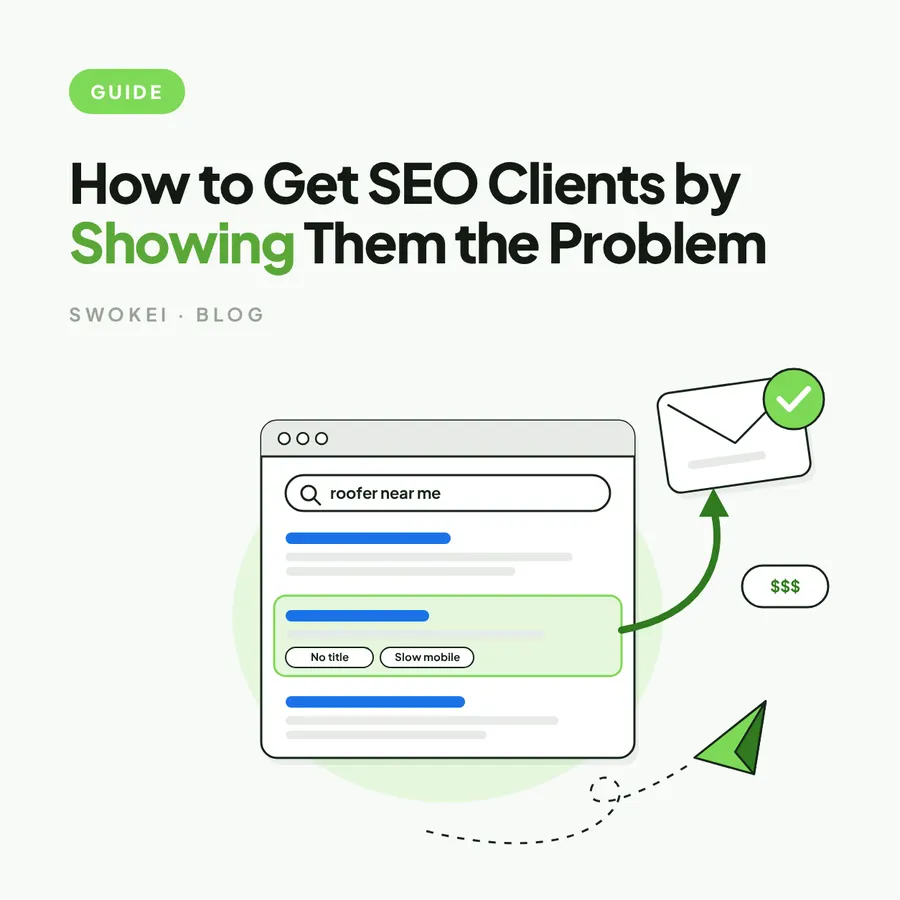
Picture a roofing company whose homepage takes 6.4 seconds to show anything on a phone, has no page title beyond the company name, and puts its quote form three screens down on mobile. Swokei finds those three things and writes an email that opens on the one most likely to cost the owner work, here the slow mobile page, because that is where people searching for an emergency roofer arrive. The email asks a small question about it rather than pitching a full redesign.
That is the whole value of the product in one example. The owner gets an email about their own site, with a detail they can check in ten seconds, instead of a template that could have gone to anyone. Whether the finding is accurate and worth raising is something you can judge for yourself before paying, which matters more than any description of it.
The analysis is not a full technical audit, and it is not meant to be. It looks for the handful of problems an owner would recognise and care about, not every warning a developer tool would raise. Agencies wanting a detailed audit report for a client will still need a dedicated audit tool alongside it.
What the free plan lets you check first
The free plan gives 20 credits, 20 lead searches and one campaign, with no card required. That is enough to pull 20 businesses from a city and category you actually sell to, have their sites analysed, and read the 20 emails Swokei writes. You cannot send them from your own mailbox on the free plan, which is where it stops.
That limit is the right one for a test. Twenty emails is enough to see whether the findings are real and whether the writing sounds like something you would put your name to. If most of them would embarrass you, you have your answer for free.
See what's wrong with any website in seconds
The free analysis checks speed, mobile and SEO, then shows what to say to the owner. No signup, no card.
Where Swokei falls short of the obvious alternatives
No tool fits every agency, and Swokei's gaps are specific enough to name. Three of them rule it out for some buyers outright, and it is better to know that before a trial than after a month of subscription. Each one is a design choice rather than a bug, which also means none of them is likely to change soon.
It does not do LinkedIn or calling
Swokei sends email sequences and nothing else. There is no LinkedIn step, no profile view, no connection request and no dialler built into the sequence. Agencies that win most of their work through LinkedIn conversations will find half their process missing, and a multichannel tool will suit them better.
For agencies selling to trades, clinics, restaurants and shops, the gap matters less. Those owners rarely live on LinkedIn, and the address on their own website is usually the one they read. The phone number comes with each lead, so a call after an email is still possible, it just happens outside the tool.
Its lead search is not a people database
Leads in Swokei are found by place and category, so the search returns businesses with their website, phone number and opening hours. It does not return named people with job titles, company size filters or direct dials. If your ideal client is defined by a role inside a mid-sized company, a dedicated data provider will find them and Swokei will not, which is the gap that the comparison with Apollo covers from the other side.
Lists from a data provider can still be imported into Swokei, and leads you bring yourself are never metered. Some agencies run both that way, with one tool finding the person and the other deciding what to say. That works, but it means paying for two tools, which changes the maths on whether Swokei alone is worth it.
There is also no enrichment step that finds an owner's personal address. Swokei works with the contact details a business publishes, which for small businesses is usually enough. For larger firms where the right person hides behind a generic info address, that limitation shows quickly.
It is not the cheapest way to send a lot of email
If the plan is several thousand lightly personalised emails a week, a high-volume sending platform will cost less per message. Swokei's credits pay for reading each site, and that cost is wasted if the email that goes out barely uses what was found. The Instantly comparison lays out where a volume sender is the better fit and where it stops being one.
The trade becomes worth it when each reply could become a project worth a few thousand. At that value, a list of 500 well-researched leads a month beats 5,000 generic ones, and the per-credit cost stops being the number that matters. Agencies selling small one-off fixes at low prices may find the maths never works.
Which agencies get their money back
The agencies that keep paying for Swokei tend to share a few traits. They sell work that a website's visible problems make a case for, they target owners who read their own email, and they reply to interested prospects quickly. None of those depend on agency size, but they do depend on the kind of client you chase.
Team size changes the plan rather than the verdict. A solo freelancer rarely needs more than Basic, while a studio with three or four people prospecting different cities usually lands on Pro. Seats tend to run out before credits do, so count logins first.
The fit is strongest for local and small business work
Redesigns, speed fixes, local SEO and care plans are all easier to sell when the email names a real problem on the prospect's site. A plumber with a 7-second mobile homepage or a dentist whose booking button fails on phones is a warm conversation, not a cold one. That is the kind of finding Swokei is built to surface, and reading redesign signals explains why those details carry so much weight.
The return is easy to estimate. One signed redesign at $3,000 pays for five years of Basic, so the question is only whether the outreach produces one extra project in a year. Most agencies that see replies in the first month can answer that quickly.
Speed of reply matters as much as the email. An interested owner answered the same morning books a call far more often than one left for two days. If nobody on the team can watch the inbox, the outreach will underperform whatever tool writes it.
The fit is weakest where sites are already good
Swokei has the most to say about websites with visible problems. Prospects whose sites are fast, modern and well built give it little to write about, and an email built on a minor finding can read as nitpicking. Agencies targeting businesses that already invest in their sites will get less out of each credit.
That is not a reason to avoid it entirely, but it is a reason to filter. Spending credits on sites that score well wastes them, while spending them on sites with real issues is where the product earns its keep. A campaign's score rules can do that filtering automatically.
Weighing up tools?
Honest comparisons with the tools agencies already use, including where they beat Swokei.
What the first month on a paid plan looks like
The first month is mostly setup, which surprises people who expect replies in week one. New sending domains and mailboxes need around two weeks of warmup before they carry real volume, and Swokei runs that warmup inside the plan. Sending properly from day one on a fresh inbox is the quickest way to land in spam.
While the inboxes warm, the time is best spent building the first campaign. Pick one city and one category, pull around 200 leads, and read the emails Swokei writes for the first 30 before turning sending on. Edits made at that stage carry through the whole campaign, so it is where an hour of attention pays back most.
Judging it fairly after 30 days
A fair verdict needs about 300 leads contacted with the full follow-up sequence. Below that number, a single good or bad week swings the reply rate too much to read anything into it. Positive replies at 2 percent or more of leads contacted suggests the findings are landing, while anything under 1 percent points to targeting or message problems worth fixing before blaming the tool.
Compare it against whatever you did before, not against a perfect benchmark. If the old process produced one call a month from a day of manual research, and Swokei produces three from an hour of review, it has paid for itself. If the numbers are flat after a properly warmed month, cancelling costs nothing beyond that month.
A fair test you can run before paying
Reading reviews of a tool like this only goes so far, because the real question is whether its findings would work on your prospects. Testing that takes less time than reading another comparison, and it does not need a signup. It also tells you more than any review can, because it uses your own prospects.
Pick three sites from your next prospect list, ideally ones you already know well enough to judge. Run each through the free website analyser, which asks for no email or card and returns the same SEO, mobile and speed findings Swokei writes from. If what comes back is specific enough to open a conversation with each owner, the free plan's 20 emails are worth an afternoon. If it is not, Swokei is not worth it for your agency, and five minutes is a cheap way to find out.
Run it on a real site before your next pitch
Analyse a prospect's site for free, or start free and let Swokei write the email from what it finds.