Most agency cold emails fail for one obvious reason: they ask for attention before they’ve earned relevance. If you sell redesigns, UX work, or web performance improvements, personalized outreach for agencies is not about adding a first name or company name to a template. It is about showing, in the first few lines, that you looked at the prospect’s site and found something worth fixing.
That changes the dynamic immediately. You are no longer another sender offering “help with digital growth.” You are pointing to a slow mobile homepage, a broken layout section, confusing navigation, weak calls to action, or a credibility gap that is visible on the site itself. For web design agencies, that is the difference between spam and a real sales conversation.
Why personalized outreach for agencies performs better
Buyers do not reply because your email sounds polished. They reply because it feels relevant to a problem they already have, even if they have not prioritized it yet.
That matters more in web design than in many other service categories. A bad website is public. It affects lead generation, user trust, mobile conversion, and brand perception. When your outreach references a concrete issue on the prospect’s site, you remove the usual friction of cold email. You are not trying to manufacture need from scratch. You are surfacing a problem that already exists.
Generic outreach usually misses this. It relies on broad claims like “we help businesses improve their websites” or “we noticed opportunities to boost conversions.” That language is easy to ignore because it could be sent to anyone. Precision is what gives outreach weight.
There is also a commercial angle. Agencies are often competing against internal teams, freelancers, and other shops that all claim good design and better performance. Specific outreach gives you a more defensible opening. If your first email includes an actual observation, you are proving competence before the first call.
What personalization should actually look like
Good personalization is not decorative. It is diagnostic.
If you are emailing a prospect about a redesign, your message should reference something tangible on the site: page speed issues on mobile, weak visual hierarchy above the fold, inconsistent spacing, inaccessible contrast, outdated testimonials, confusing menu structure, or forms that create unnecessary friction. These are not filler details. They are the reason your outreach deserves a response.
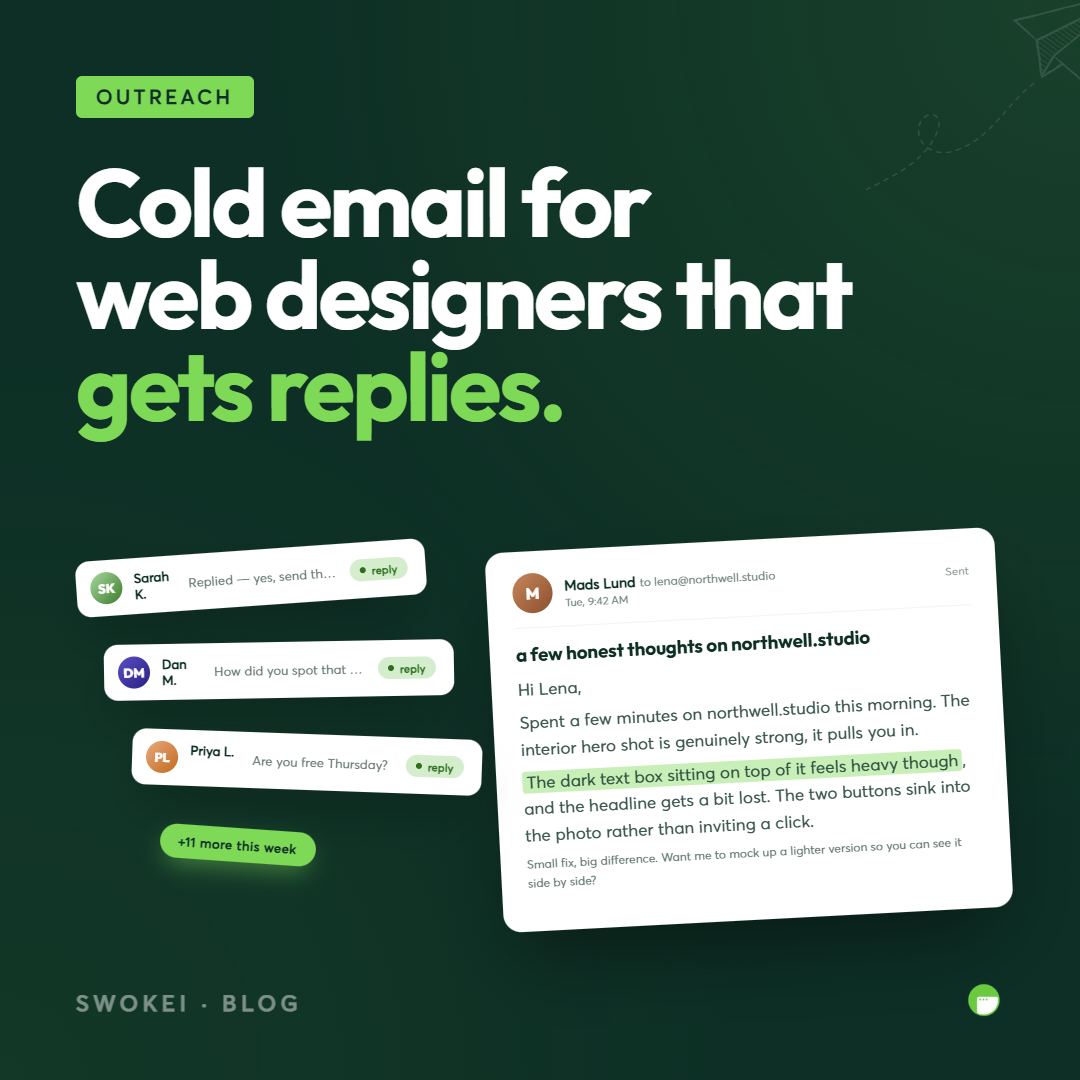
The strongest emails usually do three things in quick succession. They identify the issue, connect it to a business consequence, and suggest that fixing it is practical. For example, saying that the homepage hero takes too long to load on mobile is useful. Explaining that this likely affects bounce rate and first impressions makes it commercially relevant. Offering to share a few concrete fixes keeps the ask light.
There is a trade-off here. If you go too deep, the email becomes an unsolicited audit and starts to feel heavy. If you stay too vague, it loses credibility. The sweet spot is one or two sharp observations that show real attention without overwhelming the prospect.
The workflow problem most agencies run into
Every agency owner understands the logic of tailored outreach. The issue is execution.
Manually reviewing fifty sites a day is slow. Reviewing two hundred is unrealistic. Reviewing thousands is not a sales process. It is an operational bottleneck dressed up as personalization.
This is where many teams fall back to generic campaigns. They know specifics work better, but they cannot justify the time required to research every lead, write every email from scratch, and still maintain volume. The result is predictable: either quality drops or output drops.
That is why personalized outreach for agencies has to be built as a workflow, not just a copywriting tactic. You need a way to source prospects, analyze sites consistently, extract useful findings, and turn those findings into inbox-ready messaging without rebuilding the process every day.
When agencies solve that workflow problem, outbound starts to behave differently. SDRs spend less time hunting for angles. Founders stop writing one-off emails late at night. Campaigns become easier to test because the personalization is structured rather than improvised.
How to build a personalized outreach system that scales
Start with your offer, not your email template. If you sell homepage redesigns, your outreach should focus on issues tied to first impressions, clarity, speed, and conversion paths. If you sell broader rebuilds, you can widen the lens to UX, trust signals, brand consistency, and mobile behavior. The point is to define what kinds of flaws matter commercially for your agency.
Next, decide what evidence counts. Not every website imperfection deserves to appear in a cold email. Some findings are too minor to motivate action. Others are too technical for a first touch. Focus on observations that are easy to understand and clearly connected to user experience or revenue. Slow mobile performance, broken sections, visual clutter, weak hierarchy, and hard-to-find calls to action are all stronger than niche technical complaints that a non-specialist buyer may not care about.
Then standardize the message structure. Your outreach does not need twelve variants for every prospect type. It needs a clear pattern that can adapt to real findings. A simple structure works best: acknowledge the company, mention one specific issue, explain why it matters, and invite a low-friction next step. That keeps the email short while still earning attention.
Finally, measure the right thing. Reply rate matters, but not all replies are equal. If personalization is working, you should see better-quality responses, more problem-aware conversations, and shorter paths to qualification. A campaign that gets fewer total replies but more serious opportunities may be stronger than one with more noise.
Where agencies get it wrong
One common mistake is confusing personalization with flattery. Telling a prospect you “love what they are doing” or that they have a “great brand” adds nothing unless it leads to a credible observation. Empty compliments feel automated because they usually are.
Another mistake is over-automating the wrong layer. If your process can generate high volume but the underlying insights are weak, you are just producing generic email faster. Automation only helps if the data going into the message is specific enough to create relevance.
There is also the issue of tone. Agency outreach often swings between two bad extremes: stiff and corporate, or overly casual and clever. Neither helps. Buyers respond best to direct, useful language. If you found an issue, say what it is. If it likely affects conversions or trust, say that too. You do not need theatrics.
And then there is targeting. Even the best personalized email underperforms if the prospect is a poor fit. Agencies that sell redesigns should focus on businesses where website quality has visible commercial value. A dated brochure site for a tiny local company is not the same opportunity as a growth-stage B2B firm with clear acquisition goals and a weak mobile experience. Personalization improves conversion, but it does not fix bad prospect selection.
The case for speed and specificity together
The real advantage is not just personalization. It is personalized outreach delivered at a pace that supports pipeline.
That combination is hard to achieve manually, which is why more agencies are moving toward systems that analyze prospect websites and convert those findings into ready-to-send outreach. Done well, this gives sales teams a practical middle ground between handcrafted one-offs and generic bulk sending.
For agencies selling web work, that is a particularly strong model because the source material is already there. The website itself provides the proof, the angle, and often the urgency. A good process simply turns that into outreach that sounds informed rather than templated.
Tools can help here, but only if they are aligned with the actual job to be done. The goal is not “AI emails.” The goal is fewer hours wasted on manual research and more first-touch messages that make a prospect think, fair point, this site does need work.
That is why specialist platforms tend to outperform broad outreach tools for this use case. If your system can identify design and performance flaws, structure them into usable talking points, and prepare outreach around those findings, your team spends less time manufacturing relevance and more time starting qualified conversations.
Swokei is built around that exact workflow - turning website flaws into personalized outreach, so agencies can move from raw prospect lists to credible cold emails without the usual research bottleneck. If you want to test a faster way to run outbound for redesign offers, you can start with 20 free credits, no credit card required.
The agencies that win with outbound are rarely the loudest. They are usually the ones who show up with a sharper point of view, a clearer observation, and a better reason to be in the inbox at all.