Most web design agencies do not have a lead problem. They have a relevance problem. If you are trying to figure out how to get web design clients, the issue is usually not volume. It is that your outreach, positioning, or follow-up does not give prospects a clear reason to reply now.
That matters because web design is rarely an impulse buy. Most prospects already have a site. They may not love it, but replacing it competes with other priorities, budgets, and internal politics. So the agencies that win more deals are not always the best designers. They are the ones that show up with a specific problem, a credible point of view, and a simple path to action.
How to get web design clients without relying on luck
A reliable client acquisition system has four parts: who you target, what problem you lead with, how you start the conversation, and how you move interest into a sale. If one of those parts is weak, everything downstream gets harder.
Many agencies try to fix this by doing more of everything. More cold emails, more networking, more social posts, more proposals. That usually creates noise, not momentum. A better approach is to tighten the workflow so each conversation starts from actual relevance.
Start with a narrower market than feels comfortable
Generalist positioning sounds safe, but it makes outreach harder. If you serve dentists, law firms, SaaS startups, manufacturers, and restaurants with the same offer, your message turns vague fast. Prospects do not see why you understand their business, and you lose the easiest source of trust.
A narrower focus gives you better language, better examples, and faster sales calls. You start noticing patterns in site structure, conversion issues, and buyer behavior inside that niche. A private clinic site has different friction than a B2B software company. A local home services brand has different redesign triggers than a multi-location retailer.
You do not need to lock yourself into one niche forever. But if you want a predictable pipeline, choose one segment where you can build proof and repeatable outreach for the next 90 days.
Lead with flaws the prospect can verify
This is where most agencies lose deals before the conversation even starts. They pitch outcomes that every agency promises: better branding, stronger UX, more conversions, modern design. Those outcomes matter, but they are too abstract in a first touchpoint.
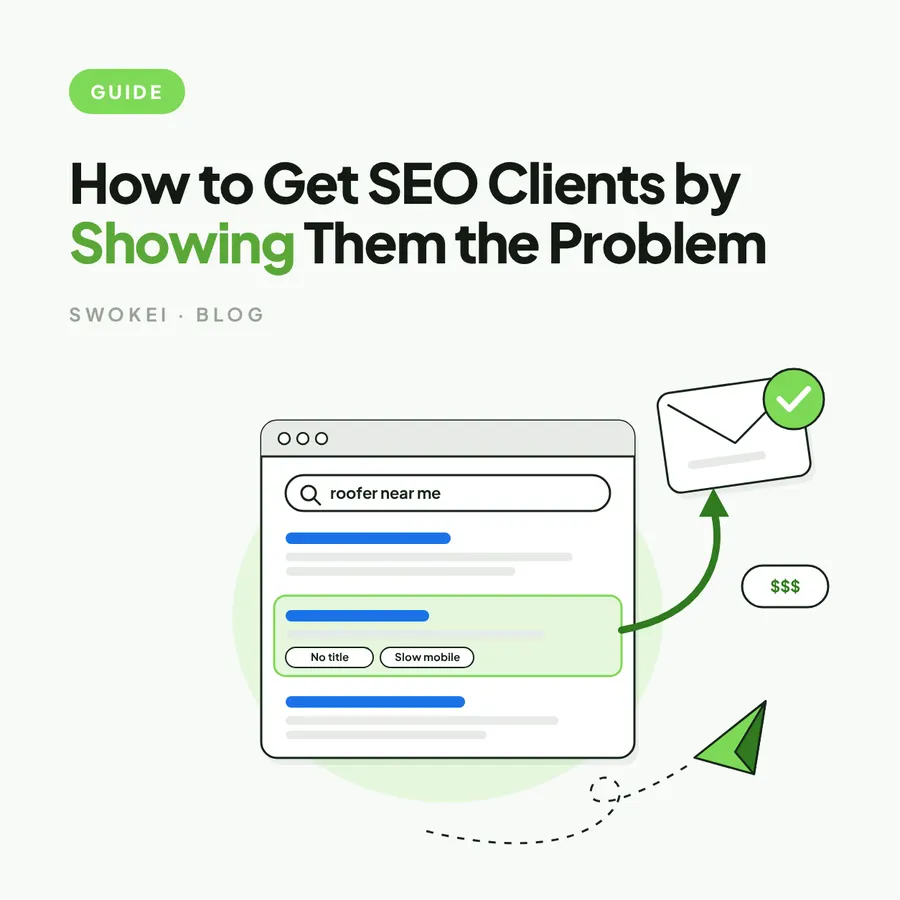
A stronger angle is to point to something the prospect can verify in 10 seconds. Slow mobile load speed. Broken spacing on key pages. Weak CTA hierarchy. Confusing navigation. Forms that ask too much too early. Layout issues that reduce trust. Messaging that buries the offer.
When your outreach is grounded in visible evidence, it stops sounding like a template. It sounds like you paid attention.
That does not mean sending a 20-point teardown to every lead. In fact, too much detail can work against you. The goal is to identify one to three issues that are commercially relevant and easy to understand. Enough to prove you are not guessing. Not so much that you give away the whole audit for free.
See what's wrong with any website in seconds
The free analysis checks speed, mobile and SEO, then shows what to say to the owner. No signup, no card.
Build an outbound system that actually gets replies
Outbound still works for agencies. Bad outbound does not. If your current process is scraping a list, dropping the company name into a template, and asking for a call, you are competing with every forgettable sales email in the inbox.
Good outbound has a clear workflow. You source the right companies, analyse their websites, prioritise the most obvious issues, and turn those findings into short personalised emails. The email should feel like a useful observation, not a pitch deck in paragraph form.
Keep the message short and specific
Most prospecting emails fail because they explain too much. A prospect does not need your agency story, service menu, or process overview in the first message. They need a reason to believe the email was meant for them.
A simple structure works best. Mention one relevant issue. Explain why it matters in practical terms. Suggest a low-friction next step.
For example, instead of saying you help businesses improve their digital presence, say that their mobile homepage takes too long to render and pushes the primary CTA below the fold. That is concrete. It connects design quality to lead generation. It earns attention.
The trade-off is that this approach takes more effort than generic mass emailing. But that effort is exactly what improves reply quality. Fewer sends, stronger relevance, better conversations.
Use scale carefully
Agencies often hit a ceiling here. Manual research produces better emails, but it burns too much time. Pure automation increases volume, but quality drops. The answer is not choosing one or the other. It is using automation where it supports precision.
That is why specialised workflows tend to outperform generic cold email setups. If your system can analyse prospect sites, detect visible design and performance flaws, and turn those findings into personalised outreach, you keep the relevance without creating a research bottleneck. Swokei is built for exactly that use case, and it is useful if your team wants to turn website flaws into outbound conversations at scale.
Referrals still matter, but they need a system too
If you only wait for referrals, growth will stay uneven. But if you ignore referrals, you are leaving easy revenue on the table. The best agencies treat referrals as an active channel, not a pleasant surprise.
That means asking at the right moment. Not randomly, and not only after a project wraps. The right time is usually when a client has seen a clear win: improved lead flow, cleaner positioning, faster site performance, better stakeholder feedback. That is when your value is easiest to describe.
Make the ask simple. Do they know another business with a dated site, weak conversion flow, or an upcoming rebrand? Specific prompts beat vague requests every time.
You can also create referral momentum by staying visible after delivery. Share useful observations, quick wins, or site improvement ideas with former clients. Not every touch needs to sell something. Some of the best opportunities come from reminding people you still notice what affects their website performance.
Weighing up tools?
Honest comparisons with the tools agencies already use, including where they beat Swokei.
Content can support sales, but it should not replace prospecting
A lot of agencies ask how to get web design clients through SEO, LinkedIn, or thought leadership alone. It can work, especially over time. But content is slow compared with direct outreach, and for many small agencies, the opportunity cost is high.
That does not mean you should ignore content. It means you should use it as sales support. Publish teardown-style insights. Show before-and-after thinking. Break down common conversion mistakes in your niche. Share what good redesign decisions actually look like.
This type of content helps in two ways. First, it gives prospects a reason to trust your judgment after they receive your email or referral. Second, it sharpens your own positioning because you are repeatedly articulating the same commercial problems.
The mistake is expecting content alone to create a pipeline next month. For most agencies, it works better when paired with outbound and referrals.
Your proposal process decides whether interest turns into revenue
Getting replies is not the finish line. Plenty of agencies can book calls. Fewer can convert them consistently.
The usual reason is that the sales process becomes vague after the first conversation. The prospect heard a good diagnosis, but then receives a generic proposal with pages of deliverables and no sharp connection to business impact.
A strong proposal should carry the same relevance as the first email. Tie your recommendation to the exact issues discussed. Show what changes, why it matters, and how the engagement will be staged. If the project includes strategy, UX, copy, design, and development, explain the order and purpose clearly.
Price presentation matters too. If your only move is a single fixed number, you force the buyer into a yes-or-no decision too early. In many cases, a tiered scope or phased approach makes the deal easier to start. That is especially useful when the prospect agrees there is a problem but is unsure about timing or budget.
There is a trade-off here. More options can improve close rates, but too many can create hesitation. Keep the decision simple enough to act on.
The agencies that win more clients sound more certain
Not louder. More certain.
They know who they help. They know what flaws to look for. They know how to turn those flaws into relevant outreach. And they know how to move from first message to proposal without losing the thread.
If your pipeline feels inconsistent, do not start by adding more channels. Tighten the one you can control. Pick a niche. Build a prospect list that fits. Lead with visible website issues. Write shorter emails. Follow up like a professional, not a bot. Then track where deals actually stall.
That is how to get web design clients in a way that compounds instead of resetting every month.
If your team wants a faster way to source leads, analyse websites, and generate personalised cold emails for redesign outreach, Swokei gives you a practical workflow to do it without the manual research drag. You can try it with 20 free credits, no credit card required.
Run it on a real site before your next pitch
Analyse a prospect's site for free, or start free and let Swokei write the email from what it finds.