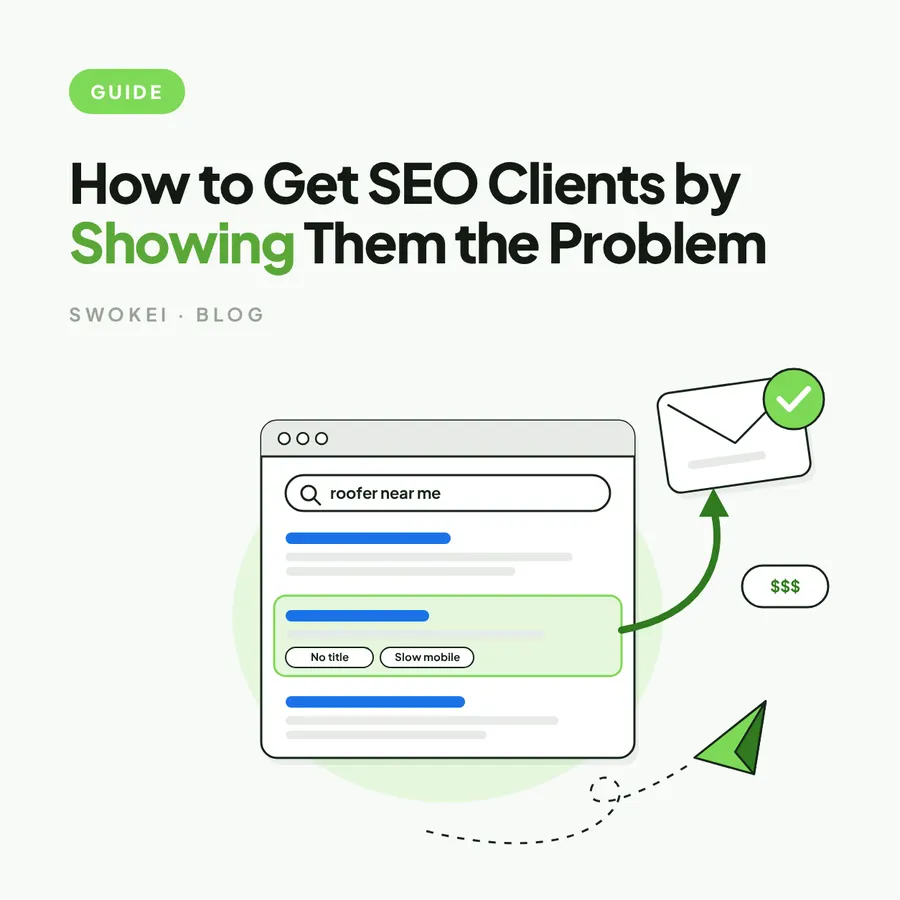
Most agencies do not have a lead problem. They have a relevance problem, and a filtering problem behind it. The best lead generation for agencies rarely comes from adding channels, tools or volume; it comes from sending the right message to a company that can buy, with a reason to reply that sits on its own website. A list of 5,000 local businesses is not a pipeline, but 300 companies with slow mobile pages, buried enquiry forms and a budget that fits your minimum project is very close to one.
That distinction decides how a sales week goes. A broad list with a broad pitch produces polite silence, a few unsubscribes and the odd reply from someone who will never spend more than a few hundred on a website. A narrow list built on evidence produces fewer replies, but they come from owners who checked the problem you named and want to know what fixing it involves. Everything below is about building the second kind of list: where the leads come from, how to qualify them and how to tell whether it is working.
Why most lead generation for agencies stalls
Agencies usually run on whatever channel worked first. Referrals are excellent until they slow down, and they always slow down eventually. Paid ads can work, but they are expensive to tune and suit agencies with a sharp niche and a healthy close rate. Content and SEO compound well, but they are a long game and do nothing for a pipeline gap this quarter.
Where each channel fits
None of these channels is useless, and the right mix depends on deal size, niche and how specific the offer is. An agency with a strong referral network in one local sector may get its best margin by staying there. LinkedIn can support prospecting, but it is crowded with generic connection requests and tired scripts, and cold calling still books meetings in local markets when the rep is good and the timing is right. For a broader view of how these fit together over a year, the guide to getting web design clients consistently covers the balance between them.
Why outbound wins for redesign work, when it is earned
For agencies selling redesigns into small and mid-market businesses, cold email is usually the fastest route to qualified conversations, because it is direct, measurable and scalable. It only works when the opening line is earned. A line about helping brands grow gives nobody a reason to take a meeting, while noticing that the mobile hero takes six seconds to load and the pricing button disappears below the fold on an iPhone gives the owner something to check right now. A redesign is rarely bought because someone liked a template; it is bought when the buyer sees a problem, accepts what leaving it unfixed costs, and trusts the sender to solve it.
See what's wrong with any website in seconds
The free analysis checks speed, mobile and SEO, then shows what to say to the owner. No signup, no card.
Lead sourcing: build the list around evidence
Lead sourcing is not just building a list of companies in your niche. It is finding accounts that are commercially viable and have a visible reason to hear from you. A company can match your ideal client profile perfectly and still be a poor target if its site was rebuilt last year and loads in under two seconds. Treat sourcing as a relevance exercise rather than a data exercise and the list gets smaller and much better.
Start with market fit
Industry, company size, geography, service model and likely budget still come first. A solo consultancy and a multi-location healthcare group may both have weak websites, but they are not equal opportunities if your projects start at $15,000. Narrowing the segment also helps later, because website standards, project economics and buying behaviour differ sharply between, say, dental clinics and industrial manufacturers. Contact databases are good at this layer, and agencies comparing them often start from the Apollo alternative for web design agencies to see which ones suit website work.
Add timing signals where you can find them
Timing is rarely perfect in outbound, but some signals improve the odds. Hiring for a marketing role, opening a new location, recent funding, a rebrand that the website has not caught up with, or a jump in paid search activity all suggest the website is about to matter more. Businesses spending money on ads feel a slow landing page most, because every visitor who leaves early is a click they paid for. None of these signals is proof, but a lead with one of them deserves to move up the queue.
Then look at the website itself
This is the layer that turns a company on a list into a lead. Instead of stopping at firmographic filters, check the site for problems that justify outreach: a 7.2 second mobile load, a contact form that sits below four screens of text, a 3,400px hero image served to phones, a navigation that collapses over the logo, or service pages with no reviews or case studies anywhere. Running a prospect through the free website analysis shows the kind of speed, SEO and mobile findings that make a credible first line. The aim is enough evidence to write one sharp email, not a twenty-minute teardown per domain, and that is the part worth taking off people's hands, as covered in the guide to automating prospect research.
Lead qualification for web agencies: four filters
Many agencies qualify like a generic B2B sales team: headcount, revenue band, location, perhaps tech stack. That gives a target list, not a qualified one. For a web agency, a lead is qualified when the site has visible problems, those problems are serious enough to justify a project, and the business looks able to buy. Scoring every lead against four simple filters is enough, as long as the team actually uses them.
Website quality
This is the most agency-specific filter and the one most often skipped. Look for issues that create commercial risk rather than aesthetic annoyance: slow mobile speed, a user flow that dead-ends, missing trust signals, layouts that break on small screens or a conversion path that is hard to find. A slightly inconsistent typeface is not the same as a homepage that takes forever to load on mobile. Qualification gets stronger when it ranks defects by their effect on enquiries, trust and usability.
Business fit
A company can have a flawed site and still be a poor lead. It may be too small to buy, operate in a market that buys on price alone, or win nearly all its work through referrals so that the website carries little weight. A five-person local business with a weak site is easy to diagnose and hard to sell at a mid-range fee. A multi-location business with obvious digital friction and a clear commercial offer usually deserves attention first.
Likely urgency
A mediocre-fit lead with real urgency can outperform a perfect-fit lead with none. Urgency often shows on the site itself: new messaging bolted onto an old template, a product range that has outgrown the navigation, obvious patchwork edits or a neglected site behind a clearly active business. This filter is partly a matter of probability, and that is fine. The goal is better odds, not certainty.
Outreach angle
Some leads look qualified on paper but have no sharp first message. If the person sending cannot say in one or two sentences why this company should care now, the lead is not ready. A usable angle is specific, testable and tied to business impact, such as a mobile load that drags while the enquiry form sits below a long block of copy. If a lead cannot support that kind of opening, it needs more research or should wait.
Weighing up tools?
Honest comparisons with the tools agencies already use, including where they beat Swokei.
Mistakes that make sourced leads unusable
The first mistake is sourcing by niche alone. Saying the agency targets law firms or SaaS companies is a segment, not a reason to email anyone this week. Every lead still needs evidence that its website gives you an opening now. Without it, the email becomes about the agency instead of the buyer's site.
The second is overvaluing design taste. Designers notice visual issues first, but owners buy business outcomes, and telling someone their site feels dated invites a defensive reply. A slow homepage or a buried enquiry path is harder to argue with. The opposite error is chasing large companies with polished sites because they look valuable, when a mid-market firm with obvious UX debt and no in-house team is usually the better target.
The third is qualifying for pain without qualifying for budget. Some businesses tolerate a poor website for years because it is not central to how they grow. The fourth is sending the same observation to every lead, which turns personalisation into decoration. If every email says the site could convert better, none of them say anything.
From qualified lead to sent email
A practical workflow looks simple from outside: a tight segment, sourced domains, website analysis, a commercial screen, an angle per lead and campaigns launched in controlled batches. The details are where it succeeds or fails. Route leads by strength, so that accounts with a serious finding, clear fit and an easy angle go first, mid-strength accounts wait for another data point, and weak ones stay out of the sequence until something changes. That routing keeps volume matched to what the team can actually follow up.
The trade-off inside that workflow is speed against certainty. Deep manual qualification gives the best judgement but caps a founder at perhaps ten solid reviews in a morning, which is not a pipeline. Pure automation covers thousands of domains but can miss context, such as a slow page sitting on a booking platform the client is contractually stuck with. Most agencies land in the middle: automated website analysis for the heavy lifting, then a quick human pass on the strongest accounts to confirm fit and sharpen the angle before anything is sent.
The email itself should name one specific issue, connect it to a business consequence and ask for something easy to answer in under ten seconds. Do not lead with the agency's story, and do not stack five observations into a mini audit that feels heavy. The guide to writing redesign emails goes through how to frame a finding so it reads as an observation rather than an attack.
Lead generation also fails quietly when the sending setup is weak. Domain reputation, mailbox count, pacing and list quality all affect whether a good email reaches the inbox at all, and agencies often blame the offer when the infrastructure is the real cause. New mailboxes need time before they carry volume, which is covered in the guide to mailbox warmup for agencies.
How to judge whether lead generation is working
Open rates are easy to watch and tell you very little. Judge lead generation by conversation quality instead: whether replies show real intent, whether meetings come from companies inside your project range, and whether prospects mention the issue you raised. Poor sourcing creates false negatives, where agencies conclude that cold email does not work when the list simply gave nobody a reason to engage. Better qualification also shortens discovery calls, sharpens proposals and lifts close rates, because the conversation starts from something both sides can see.
Before the next campaign goes out, put three questions to every lead on the list. Why is this company a fit, why might it care now, and what exact website issue is the email about? If those answers are weak for more than a handful of rows, fix the list before touching the copy. The quickest way to answer the third question for a real prospect is to run its domain through the website analyser, which needs no signup and returns specific speed, SEO and mobile findings. Swokei is built to do the same at list scale, analysing each prospect's site and turning the real issues into personalised cold emails sent from the agency's own mailboxes, with plans on the pricing page.
Run it on a real site before your next pitch
Analyse a prospect's site for free, or start free and let Swokei write the email from what it finds.