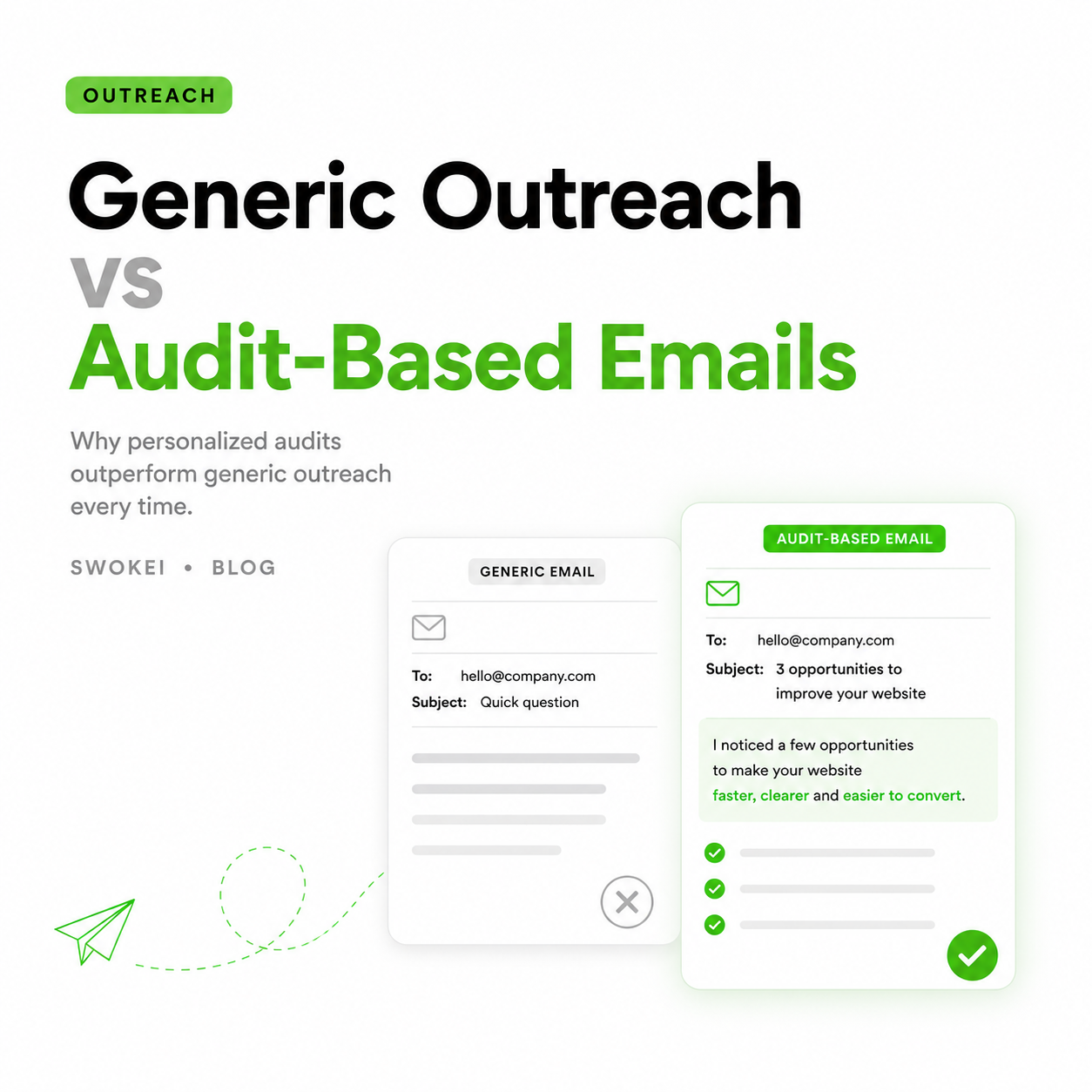
Most agencies do not have a lead problem. They have a relevance problem.
That is the real issue behind most conversations about how to scale agency prospecting. Teams buy more data, send more emails, add more SDR hours, and still get the same weak result: low reply rates, thin pipelines, and outreach that sounds like everyone else. Volume is easy. Sending messages that feel worth replying to is the part that breaks once you try to scale.
If you sell web redesign, UX improvements, branding, or broader digital presence work, prospecting only scales when three things stay intact at the same time: list quality, message relevance, and operational speed. Lose any one of those, and your outreach either slows to a crawl or turns into noise.
Why agency prospecting breaks when you scale it
At a small volume, founders and account leads can get away with manual effort. They pick a few target accounts, review each website, spot obvious issues, and write custom emails based on what they found. That usually works because the signal is strong. The prospect can tell you actually looked.
The problem starts when you want that same quality across 500, 2,000, or 10,000 prospects. Manual audits do not scale cleanly. Generic templates do scale, but they kill reply rates. So agencies get pushed into a bad trade-off: keep quality and stay slow, or increase output and lose credibility.
That trade-off is not unavoidable, but it does force a change in process. Scaling prospecting is not about doing more of the same. It means rebuilding outreach so that personalization is produced systematically instead of manually.
How to scale agency prospecting without losing reply quality
The first shift is to stop treating every lead the same. A lot of agencies try to scale from a giant, loosely filtered prospect list. That creates bad economics from the start. If your targeting is broad, your messaging has to stay broad. And broad messaging gets ignored.
Instead, tighten the market first. Pick segments where your offer is easy to explain and easy to justify. That could be ecommerce brands with slow mobile sites, professional services firms with outdated visual identity, or multi-location businesses with weak local landing page UX. Narrowing your market feels like reducing opportunity, but it usually does the opposite. It gives your team a repeatable angle.
Once the segment is clear, define what counts as a meaningful problem. This matters more than most teams think. If your outreach is built around vague criticism like "your website could be improved," it will sound lazy. If it points to a specific issue such as poor mobile load time, weak hierarchy above the fold, broken trust signals, or confusing call-to-action placement, the conversation changes. Now you are not pitching design taste. You are pointing at business friction.
That is the second shift: scale observations, not compliments. A lot of personalization in cold email is fake personalization. Mentioning a company name, referencing an industry, or saying you liked their brand does not create relevance. It just proves you can use merge fields. What gets attention is a concrete observation tied to a likely commercial downside.
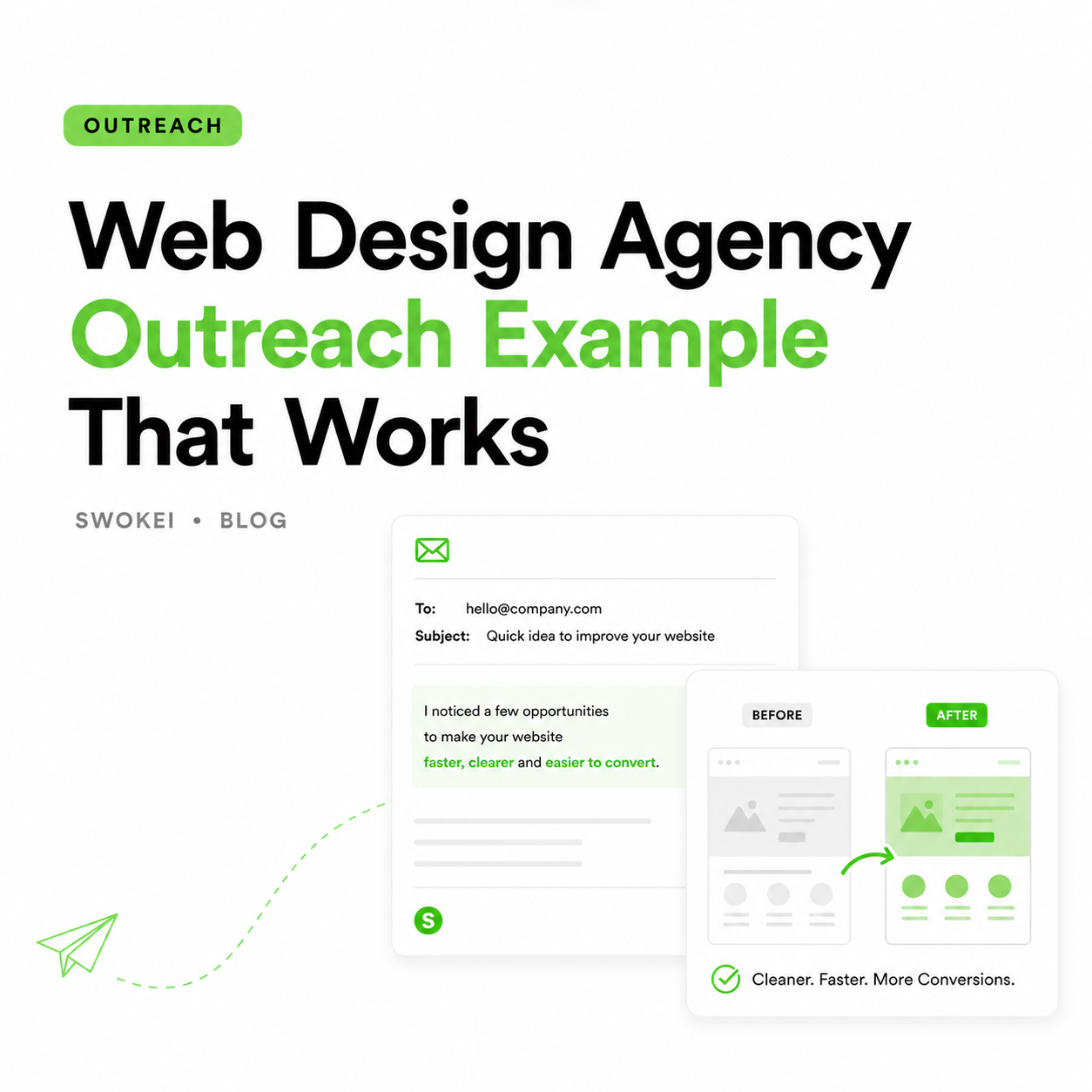
For a web agency, that could mean showing that a homepage takes too long to load on mobile, key page elements stack poorly on smaller screens, forms create unnecessary friction, or visual inconsistencies weaken trust. These are useful because they give the prospect a reason to care now, not later.
Build a prospecting system around evidence
A scalable prospecting engine for agencies usually has four stages: sourcing, analysis, message generation, and campaign control. If one stage is weak, the rest underperform.
1. Source leads that fit your actual offer
Do not start with the biggest list you can find. Start with the list most likely to convert. If you sell redesign projects, your best prospects are not simply businesses with websites. They are businesses with visible website issues, enough commercial maturity to invest, and a reason to improve now.
That means your filtering should include practical indicators such as business type, geography, site quality, likely traffic dependence, and whether the company appears active enough to care about performance. A dated site alone is not always a good signal. Some outdated websites still convert well enough for the owner not to care. You want prospects where digital presentation clearly affects demand generation, credibility, or conversion.
2. Analyse websites at scale
This is where most agencies get stuck. Manual audits are effective but expensive. If each prospect needs ten minutes of review, a list of 1,000 sites becomes a serious operational cost before a single email goes out.
The fix is not to remove analysis. The fix is to systematize it. You need a repeatable way to identify visible flaws and performance issues across large lists, then turn those findings into usable sales inputs. That is the difference between scaled prospecting and mass emailing.
Not every flaw deserves outreach. Focus on issues that are easy to explain in one sentence and easy for a prospect to verify. If the problem requires a long technical explanation, it usually does not belong in a first-touch email. The best outreach triggers are simple, observable, and commercially relevant.
3. Turn findings into personalized outreach
Once you have real observations, writing gets easier. The message does not need to be long. In fact, shorter usually performs better. But short only works when the substance is strong.
A useful cold email for agency prospecting has a clear structure: show that you looked, point to one or two specific issues, suggest the likely impact, and offer a low-friction next step. That is enough. You do not need a paragraph about your agency history or a long list of services.
There is an important trade-off here. If you cram too many findings into one email, it starts to feel automated or overly critical. If you include too little, it feels generic. In most cases, one strong issue and one supporting point is the right balance.
4. Control volume so quality stays visible
Scaling does not mean sending as much as possible. It means sending as much as your targeting and infrastructure can support without damaging deliverability or message quality.
A smaller campaign with strong evidence-backed emails will usually outperform a bigger campaign built on weak assumptions. This is especially true in agency sales, where one positive reply can turn into a high-value redesign project. The goal is not maximum send count. It is maximum qualified conversation.
What efficient agency prospecting actually looks like
In practice, efficient prospecting looks less like creative copywriting and more like operational discipline. You choose a segment, define the issues that matter, gather leads that fit, analyse sites against those issues, and generate outreach from the findings. Then you review outputs, remove weak prospects, and launch in controlled batches.
That workflow matters because it removes the biggest bottleneck in agency outbound: research time. If your team spends hours finding and inspecting sites before writing a message, you cannot scale without hiring heavily. And hiring does not always fix the problem. It often introduces inconsistency, because different reps assess websites differently and write in different ways.
A more reliable setup creates standardization without sounding robotic. That is the sweet spot. You want every prospect to receive a message grounded in something real, but you also want the process to run fast enough that outbound becomes a repeatable channel rather than a founder-only activity.
Common mistakes when scaling agency prospecting
One common mistake is trying to personalize around trivia instead of pain. Mentioning a recent post, company milestone, or generic praise may feel tailored, but it rarely creates urgency. Website flaws do, because they affect trust, conversion, and user experience.
Another mistake is using the same angle across every segment. A slow site may matter a lot for ecommerce and far less for a relationship-driven local service business. The right prospecting angle depends on how the business wins customers. That is why segmentation should come before message production, not after.
A third mistake is over-automating low-quality inputs. Automation amplifies whatever you feed into it. If the lead list is weak or the observations are shallow, scaling just spreads low-quality outreach faster. Good systems do not remove judgment. They apply it earlier in the process.
A better standard for outbound
If you want a useful test for whether your prospecting is ready to scale, ask a simple question: would this email still make sense if the recipient forwarded it to their marketing lead or CEO? If the answer is no, the message is probably too generic, too flimsy, or too obviously automated.
The better standard is straightforward. Every outbound email should contain a reason this company should care, now, based on something visible and specific. Once you can produce that consistently, scale becomes a volume decision rather than a quality sacrifice.
That is where a focused workflow earns its value. Tools like Swokei help agencies move from raw website lists to analyzed flaws and inbox-ready personalized emails much faster, without dropping into spammy outreach patterns. If you want to test that model, you can start with 20 free credits, no credit card required.
The agencies that win outbound are rarely the ones sending the most emails. They are the ones making relevance easier to produce every day.