Most agency cold emails fail before the second sentence. Not because the offer is bad, but because the prospect can tell it was written for everyone. That is the real issue in generic outreach vs audit based email: one asks for attention without earning it, while the other starts with proof.
For web design agencies, this matters more than it does in most categories. You are not selling a simple commodity. You are asking a company to rethink its site, its UX, its conversion flow, and often its brand presentation. That conversation does not start well with "we help businesses grow online". It starts when you point to something real on their website and show that you noticed what others missed.
What generic outreach actually does
Generic outreach is broad by design. It usually relies on the same structure across a large list: quick intro, vague credibility line, broad value proposition, and a low-friction call to action. The sender may swap the company name, industry, or city, but the core message stays the same.
That approach is attractive because it is fast. A small team can load a list, write a template, and start sending within hours. If your service has wide appeal and low complexity, that can still produce replies. But for redesign services, generic messaging usually creates a trust gap. The prospect is being asked to believe that you understand their business while the email shows no evidence that you have looked at their site.
The problem is not just low relevance. It is weak positioning. A generic email makes your agency sound interchangeable with every other shop promising a better website, stronger UX, or more conversions. When ten agencies say the same thing, price becomes the easiest way for a buyer to compare them.
What audit based outreach changes
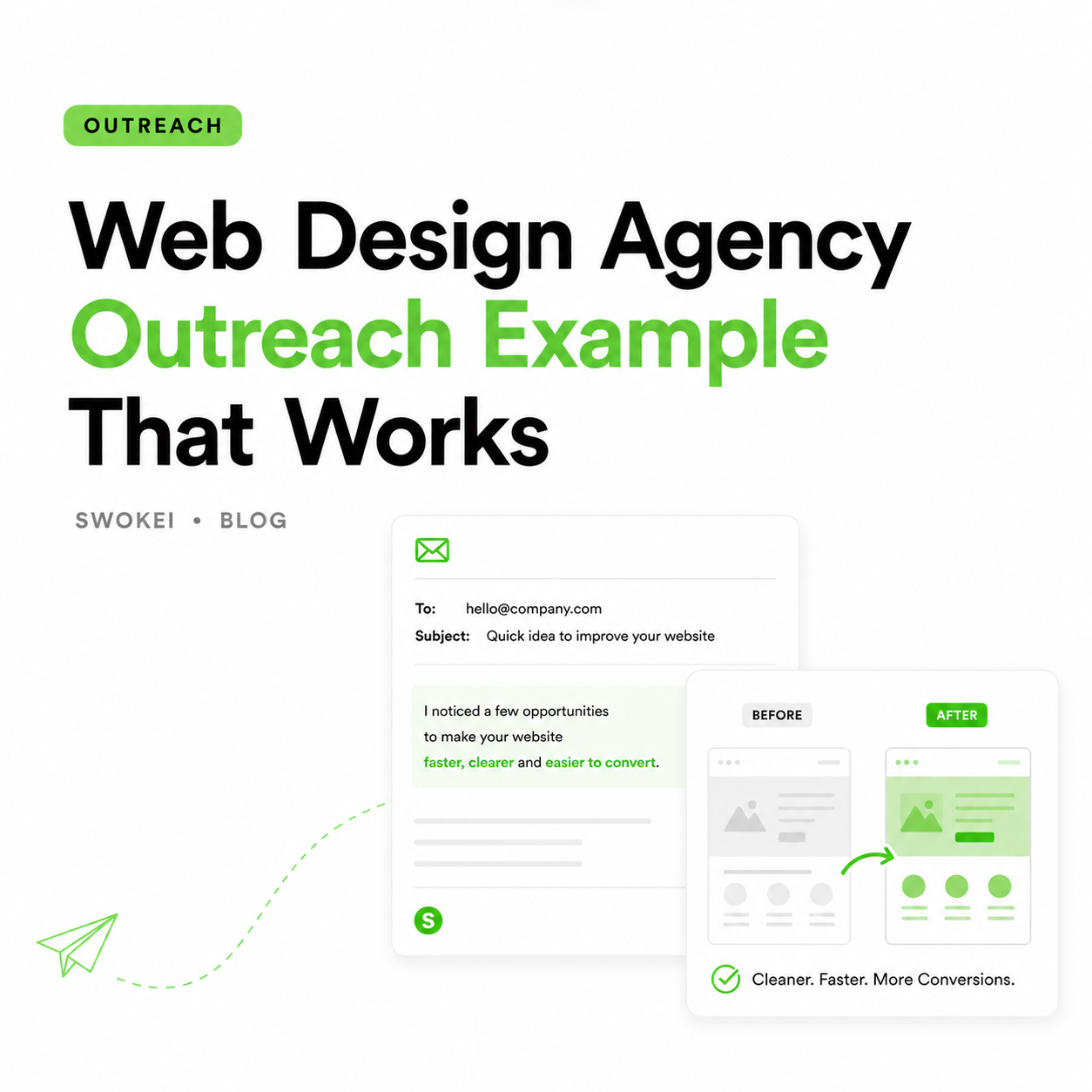
Audit based outreach starts from observation. Instead of leading with a broad offer, it leads with concrete issues tied to the prospect's website. That could be mobile speed, visual hierarchy problems, broken spacing, poor CTA placement, accessibility gaps, or confusing page structure.
This changes the entire dynamic of the email. You are no longer interrupting with a generic pitch. You are opening a conversation around something specific, visible, and commercially relevant. The message feels earned because it is based on facts.
A good audit based email does not need to be long. In fact, shorter is often better. But every line has to pull its weight. If you mention that the home page loads slowly on mobile, that the hero section pushes the main CTA too far down, or that service pages bury key trust signals, you immediately signal competence. You also reduce the mental work the prospect has to do. They do not have to imagine why a redesign might matter. You have already shown them.
Generic outreach vs audit based for reply rates
If your goal is replies, audit based usually wins because it gives the recipient a reason to respond beyond curiosity. A generic message often gets judged in under three seconds. It looks like outreach, sounds like outreach, and gets archived like outreach.
An audit based message buys more attention because it feels less disposable. Even if the prospect is not ready to buy, they may reply to confirm the issue, ask a question, or forward the email internally. That is a much stronger starting point than trying to force interest from a cold intro.
There is also a credibility effect. In web design sales, buyers are cautious because everyone claims to improve performance, conversions, and UX. Specific findings cut through that. They show that your recommendation is grounded in their actual site, not a recycled script.
That said, audit based outreach is not magic. If the observations are weak, generic, or obviously auto-generated, the advantage disappears. "Your website could improve user experience" is still generic, even if you call it an audit. Precision is the difference.
Where generic outreach still has a place
This is not a simple case of one method being always right. Generic outreach can still work in a few situations.
If you are testing new markets, validating positioning, or warming up a broad segment before tightening your offer, generic campaigns can be useful for speed. They are also easier to launch when you have limited data, unclear service-market fit, or a very large prospect pool that has not been prioritised yet.
Generic messaging can also support other channels. For example, a broad intro may be enough for follow-up after a referral, event interaction, or inbound signal. In that case, the relationship context does some of the work that a website audit would normally need to do.
The issue is using generic outreach as the main growth engine for redesign deals. That is where teams get stuck. They send volume, see weak reply rates, and assume cold email itself is broken. Usually the problem is not the channel. It is that the first touchpoint contains no proof.
Why audit based outreach is harder to scale manually
The obvious objection is time. Manual audits do produce better emails, but they are slow. If an SDR or founder has to inspect every site, identify flaws, write notes, and turn those notes into tailored copy, volume collapses fast.
That creates a trade-off most agencies know well. Generic outreach gives you scale without relevance. Manual audits give you relevance without scale. Neither is ideal if you are trying to build a repeatable outbound system.
This is why the operational side matters as much as the copy. The real goal is not just to personalise more. It is to personalise with enough speed and consistency that outbound remains commercially viable.
For agencies selling redesigns, the best setup is usually not full manual research and not pure templated blasting. It is a workflow that can analyse websites, surface meaningful issues, and turn those findings into usable outreach without turning every campaign into a research project.
What makes an audit based email credible
Not every website issue belongs in a cold email. The strongest audit based outreach uses findings that are easy to understand, relevant to business outcomes, and hard to dismiss.
A note about mobile load speed works because it connects to real user behaviour. A note about poor CTA visibility works because it ties directly to conversion friction. A note about layout inconsistency or weak content hierarchy works when it is framed around clarity and trust rather than personal taste.
The key is to avoid sounding like a designer critiquing aesthetics for sport. Prospects do not care that a section feels visually unbalanced unless you connect that issue to performance, usability, or perception. Audit based outreach performs best when it translates design observations into commercial implications.
That is also why restraint matters. You do not need to send a full teardown in the first email. One to three sharp findings are enough. Too many points can feel overwhelming or make the message look automated. The aim is to open a conversation, not deliver free strategy work.
Generic outreach vs audit based in the sales pipeline
The difference between these approaches does not stop at reply rate. It affects pipeline quality.
Generic outreach tends to produce more weak-positive replies. You may get interest from people who are mildly curious but not convinced. That can lead to more calls that go nowhere because the prospect has not yet seen a real reason to prioritise a redesign.
Audit based outreach often produces fewer but better conversations. The prospect comes in with context. They already know what issue triggered the email. They have a concrete reason to talk. That usually improves qualification, shortens the path to diagnosis, and makes pricing easier to defend.
It also changes internal agency behaviour. Teams using generic outreach often compensate by overexplaining on calls. Teams using audit based outreach can move faster because the first touchpoint has already established relevance.
The practical choice for agencies
If you are comparing generic outreach vs audit based methods, the answer is not complicated for redesign sales. Generic outreach is easier to launch, but audit based outreach is more likely to create trust, replies, and serious opportunities.
The real decision is how you plan to execute it. If your team can only personalise a handful of emails per week, the model will not scale. If your personalisation is so shallow that it reads like a template with a fake audit layer, prospects will spot it immediately.
The winning approach is specific, repeatable, and fast enough to support consistent outbound. That is where a specialised workflow matters. Tools like Swokei are built for exactly this gap: turning real website flaws into personalised outreach without forcing your team to spend hours on manual audits. You get speed, relevance, and a stronger reason for the prospect to reply. If you want to test that approach, start with 20 free credits, no credit card required.
Cold email gets better when it stops asking for attention and starts earning it.