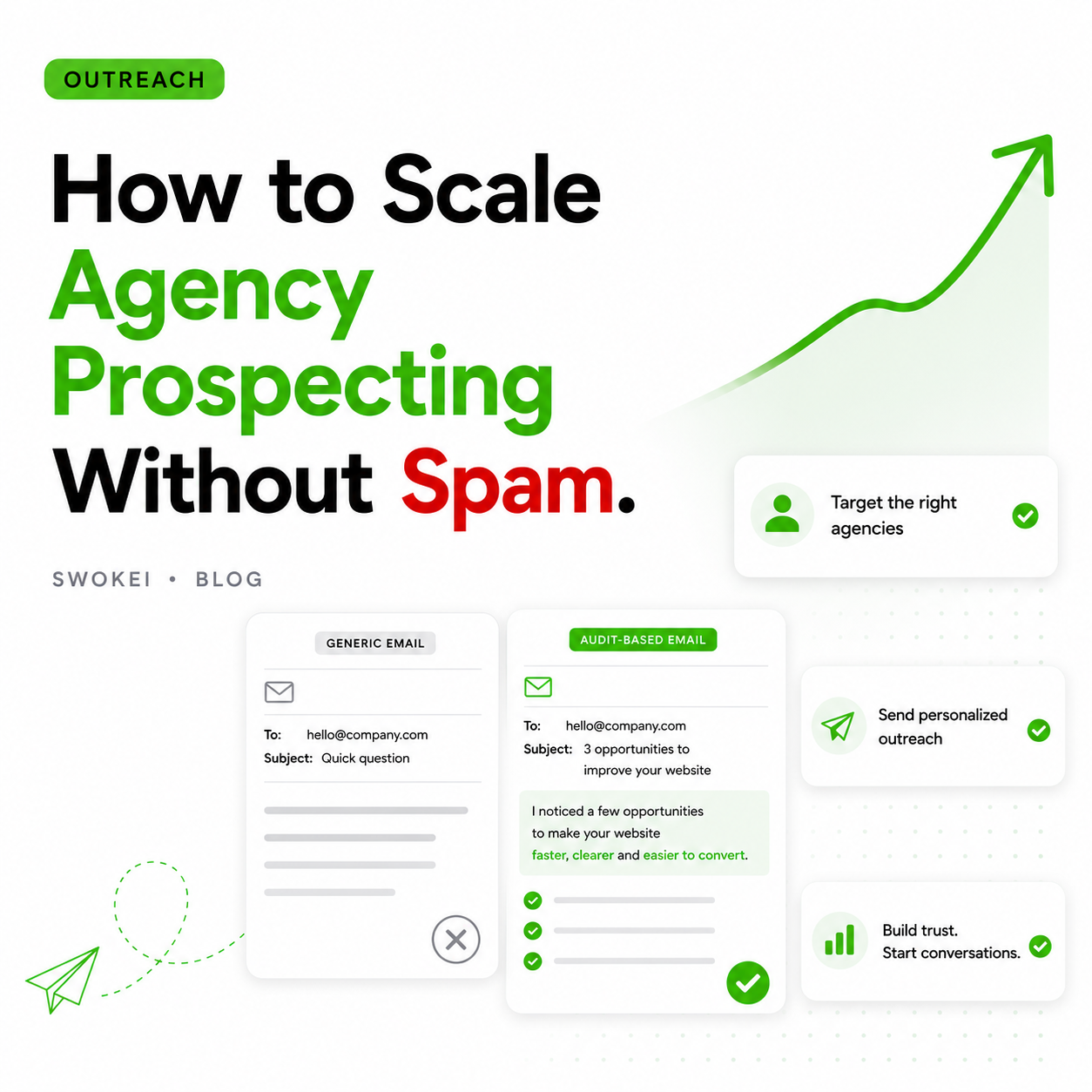
Most agency outbound breaks in the first 10 seconds. The prospect opens the email, sees a vague compliment about their brand, a generic promise to improve conversions, and deletes it. Design agency sales automation only works when it fixes that exact problem - relevance at first touch, without adding hours of manual research.
For web design agencies, that changes the whole sales equation. You are not selling a commodity service. You are selling a point of view on what is broken, what it costs the prospect, and why your team should be the one to fix it. If your outreach does not show that clearly, automation just helps you send bad emails faster.
What design agency sales automation should actually automate
A lot of teams hear "automation" and think sequences, follow-ups, and CRM updates. Those matter, but they sit too far down the funnel. The real bottleneck for most agencies happens earlier, when someone has to find decent-fit companies, review their sites, spot issues worth mentioning, and turn those findings into a message that sounds informed rather than mass-produced.
That is where design agency sales automation earns its keep. It should reduce manual prospecting work while keeping the outreach specific. In practice, that means four things happening together: lead selection, website analysis, message personalization, and campaign preparation.
If only one of those is automated, the workflow still drags. You can source thousands of companies, but if an SDR still has to manually inspect every homepage, mobile layout, page speed issue, and UX flaw, volume becomes useless. On the other hand, if you automate email sending without improving the quality of the insight inside the email, reply rates stay flat.
Why generic agency outreach underperforms
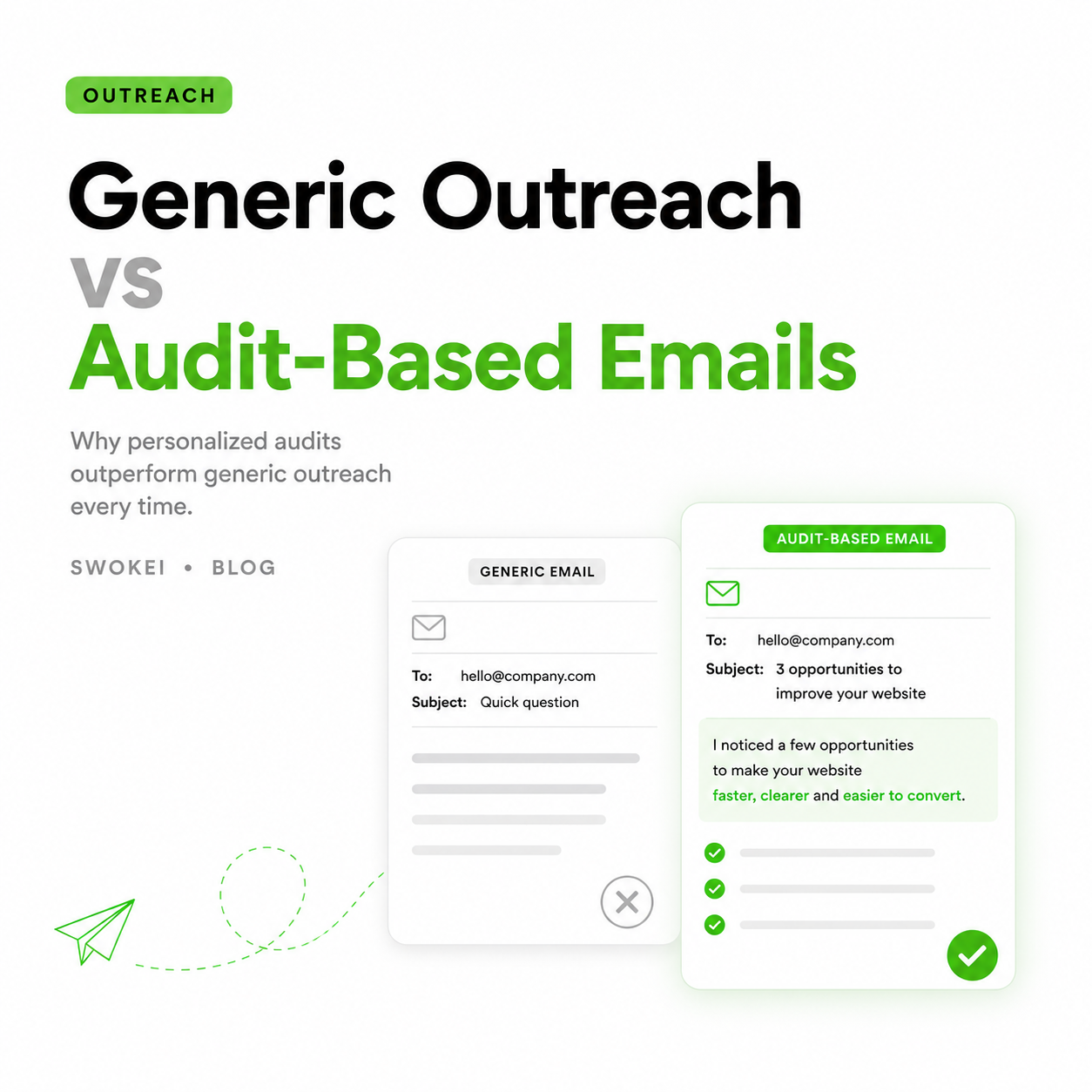
Agency inboxes are full of advice from people who clearly have not looked at the site. Prospects know the pattern. "We love your brand." "We noticed a few opportunities." "Can we help improve your online presence?" None of that proves attention. None of it creates urgency.
Good outreach for redesign projects has to be anchored in something concrete. Maybe the mobile navigation breaks on smaller screens. Maybe the hero section loads slowly. Maybe the calls to action are buried below a cluttered layout. Maybe the site looks dated compared with direct competitors. Those observations give your outreach weight because they are testable. The recipient can check them in seconds.
This is why design agency sales automation is different from broader sales automation. It is not just about moving contacts through a sequence. It is about turning site-level flaws into commercially relevant messaging. The email should make the prospect think, "They actually looked."
The workflow that scales without sounding automated
The strongest outbound systems for agencies follow a simple progression. First, define the right market segment. That could be ecommerce brands with outdated storefront UX, B2B firms with slow mobile experiences, or local businesses whose websites no longer match their positioning. If targeting is loose, even well-written emails will struggle.
Next, analyse each prospect website for visible design, UX, and performance issues. This is the part most teams either skip or do manually at an unsustainable pace. The goal is not to produce a full audit. It is to identify a few specific findings that are easy to reference in cold outreach and relevant enough to justify a conversation.
Then turn those findings into personalized email copy. Not a giant report. Not a wall of critique. Just enough detail to show credibility and create a reason to reply. A good opening line might reference a broken visual hierarchy, slow mobile load time, inconsistent trust signals, or a weak conversion path. The tone matters here. Sharp and useful beats clever. Specific beats polished.
Finally, prepare campaigns at a volume your team can actually manage. If your process creates 2,000 leads but your account team can only handle 20 qualified conversations per week, more volume is not a win. Good automation should increase throughput without breaking handoff quality.
Where agencies usually get design agency sales automation wrong
The first mistake is automating too late. Teams buy sequence software, connect a mailbox, and think the system is done. It is not. They still need a credible reason for prospects to care.
The second mistake is over-personalizing low-value details. Mentioning a recent blog post or LinkedIn update can work in some markets, but for website redesign services, site-specific flaws usually carry more weight. A prospect may not care that you noticed their team hired a new marketing manager. They will care if the checkout flow is confusing on mobile or if the homepage takes too long to render.
The third mistake is treating every flaw as equally useful in outreach. Some issues are too technical for a cold email. Others are too subjective. "Your visual identity feels tired" may be true, but it can also trigger defensiveness. "Your mobile hero image pushes the main CTA below the fold" is clearer, easier to verify, and less likely to feel like empty opinion.
There is also a trade-off between scale and precision. Fully manual prospecting gives you excellent detail but weak volume. Fully generic automation gives you volume but poor engagement. The best setup sits in the middle: automate the research and draft generation, then let a human make quick adjustments where needed.
What better outreach looks like in practice
A strong outbound message for design services does three jobs fast. It shows you looked at the site, points to a problem with business impact, and makes the next step easy.
That means the copy should stay grounded. If you mention slow load speed, connect it to user drop-off or lost conversions. If you point out a messy page structure, tie it to confusion or weak trust. If the issue is mobile responsiveness, make the implication obvious: a large share of traffic is likely seeing a weaker experience than desktop visitors.
This approach works because it reduces the prospect's mental effort. They do not have to guess what you do or why you are reaching out. The value is already framed.
It also helps agencies protect their positioning. Generic outreach pushes you toward price conversations because nothing else differentiates you. Specific outreach based on observed flaws pushes the conversation toward expertise, diagnosis, and business impact.
Choosing tools for design agency sales automation
Not every sales tool fits agency outbound. General-purpose prospecting platforms can source contacts and send emails, but they rarely understand the sales motion behind redesign work. That matters. Web design outreach depends on context from the prospect's website itself, not just company size, job title, or funding status.
When evaluating tools, look at whether they can actually analyse websites, identify actionable flaws, and convert those findings into usable first-touch copy. If your team still has to jump between lead databases, performance tools, manual screenshots, spreadsheets, and writing prompts, the process remains fragmented.
The better option is a workflow where prospect sourcing, website analysis, personalization, and campaign prep live close together. That shortens the gap between finding a lead and sending a relevant message. Speed matters because outbound dies when the process gets too heavy to maintain.
This is where specialist platforms have an edge over broad outbound stacks. A tool built for design and redesign sales can focus on the evidence your buyers actually respond to: performance issues, UX weaknesses, layout problems, and visible conversion friction. That is more useful than a generic personalization token pretending to be insight.
How to measure whether it is working
Open rates are a weak signal now, and raw send volume tells you almost nothing. For agency outbound, the healthier metrics are reply rate, positive reply rate, qualified conversations booked, and close rate from outbound-sourced opportunities.
You should also measure production efficiency. How many prospects can your team analyse and prepare for outreach in a day? How long does it take to go from raw lead list to inbox-ready campaign? If automation saves time but lowers relevance, the gain is fake. If it keeps relevance high while reducing prep time, that is where margin improves.
It is worth checking whether reply quality improves too. Better targeting and better website observations often lead to fewer total replies but more serious ones. That is a good trade. Agency sales teams do not need more noise. They need more conversations with buyers who can actually approve a redesign project.
For teams that want to stop sending vague cold emails and start turning real website flaws into personalized outreach at scale, Swokei is built for exactly that workflow. You can go from large prospect lists to site-based emails much faster, with 20 free credits and no credit card required.
The useful question is not whether to automate agency sales. It is which parts deserve automation and which still need judgment. If your system can spot real problems, frame them clearly, and help your team reach out while the insight is still fresh, you are not automating spam. You are making relevance repeatable.