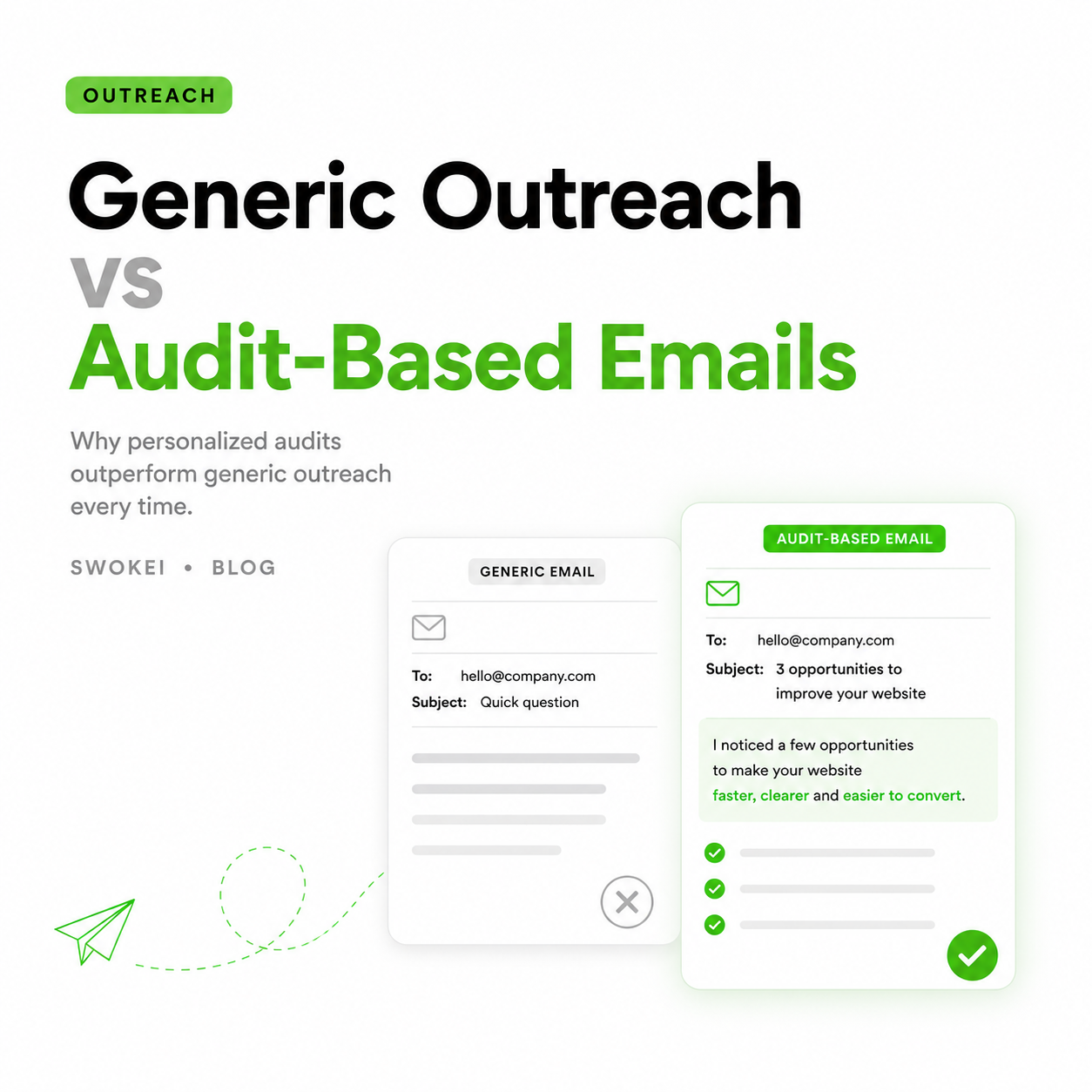
Most cold emails fail before the second sentence. Not because the offer is terrible, but because the message sounds guessed, generic, or copied from the last 200 prospects. That is why a fair question for any agency running outbound is this: can website flaws increase replies? In many cases, yes - but only when the flaw is specific enough to prove relevance and framed in a way that creates curiosity instead of friction.
For web design agencies, this matters because a website is not an abstract pain point. It is visible, inspectable, and tied directly to revenue, credibility, user experience, and lead generation. If you can point to something real on a prospect's site, you are no longer asking them to imagine a problem. You are showing them one.
Why website flaws can increase replies
A website flaw does something generic outreach cannot. It gives your email a reason to exist.
Most outreach gets ignored because the recipient has no evidence that the sender looked at their business. Lines like "we help companies improve their online presence" or "noticed your brand could use a refresh" are weak because they are transferable. You could send them to a law firm, a SaaS startup, or a local clinic without changing a word.
A real flaw changes the dynamic. If you mention that their mobile homepage takes too long to load, that the call-to-action disappears below the fold on smaller screens, or that form validation breaks on a key conversion page, you signal effort and competence at the same time. The message feels earned.
That does not mean every flaw will produce a reply. Some issues are too minor to care about. Some prospects already know about the problem. Some teams are too busy to engage even when the point is valid. But relevance raises the floor. It gives the recipient a concrete reason to pause, and that pause is where replies start.
Can website flaws increase replies in every campaign?
No, and this is where many agencies get sloppy.
Website flaws increase replies when they pass three tests. First, the issue must be observable and credible. Second, it must connect to a business outcome the prospect cares about. Third, it must be communicated without sounding like a teardown.
If you email a founder saying their button radius is inconsistent, that is technically a flaw but commercially weak. If you point out that the mobile navigation makes key pages harder to reach, or that slow load speed may be hurting demo conversions, now the issue has weight.
There is also a difference between flaws that create urgency and flaws that simply show taste. Agencies often lean too far into aesthetic critique because it feels familiar. Prospects reply more often to issues that touch usability, speed, trust, and lead flow. Design still matters, but in outreach it works better when tied to outcomes.
The best flaws to use in outreach
The strongest flaws sit in the overlap between visible problem and believable impact.
Performance issues work well because they are measurable and hard to dismiss. Slow mobile pages, oversized assets, layout shift, or poor Core Web Vitals all suggest lost patience and weaker conversion paths. UX issues also work because they are easy to picture. A cluttered hero, weak page hierarchy, hidden contact options, or confusing navigation can all make a prospect think, "Yes, that could be costing us."
Trust issues can be even more effective. Broken layouts, outdated visual patterns, missing social proof, inconsistent branding, poor spacing, or pages that feel neglected often trigger a reaction because they reflect on the business itself. People may tolerate technical debt internally, but they care when their public-facing site makes them look behind.
Accessibility and mobile responsiveness can also be strong angles, though they need careful framing. If you overstate them, the email sounds preachy. If you keep them factual and practical, they show depth.
The common thread is simple: choose flaws that matter to the prospect, not just flaws that prove you know design.
How to mention flaws without sounding insulting
This is where reply rates are won or lost.
Many agencies find a valid issue, then package it like an audit report written by someone trying to impress other designers. That approach usually kills momentum. Prospects do not want to be told their site is bad by a stranger in their inbox.
The better move is to make the observation precise and low-ego. State what you noticed, suggest the likely consequence, and keep the tone useful. You are opening a conversation, not delivering a verdict.
For example, saying "your website has serious UX and performance problems" is vague and confrontational. Saying "noticed your mobile product pages take a while to settle visually, which may be making drop-off worse on slower connections" feels measured. It sounds like you actually looked.
Specificity also protects you from the biggest problem in flaw-based outreach: false confidence. If your note is detailed enough, the prospect can tell whether you are bluffing. That is good. Bluff-based personalization burns trust fast.
Why generic personalization underperforms
A lot of outreach tools promise personalization but produce surface-level filler. They reference the company name, mention a recent post, or compliment the brand. That might lift open rates a little, but it rarely creates strong reply intent.
Reply intent comes from relevance with consequences. A real website issue is stronger than a generic compliment because it changes the prospect's internal calculation. Now they are not just reading another pitch. They are evaluating whether the sender spotted something worth fixing.
This is also why manual website reviews have always been attractive for agencies. The problem is speed. Reviewing ten sites carefully is manageable. Reviewing one thousand is not. Teams either slow down or start cutting corners, and once they start cutting corners, the quality of the personalization drops right back into generic territory.
That gap between relevance and scale is where workflow matters.
Turning website flaws into replies at scale
If you want website flaws to increase replies consistently, the process has to be operational, not artisanal.
That means your team needs a repeatable way to analyze sites, identify issues worth mentioning, filter out weak findings, and turn the strongest observations into clean outreach copy. Without that system, one SDR writes useful emails, another writes harsh ones, and a third sends messages based on half-checked assumptions.
The best process usually looks like this. Start with a defined lead segment so the flaws you surface are contextually relevant. A B2B SaaS homepage and a local service business should not be judged the same way. Then analyze each site for issues with likely business impact, especially on mobile experience, load behavior, navigation clarity, trust elements, and conversion paths.
After that, narrow down to one or two findings per email. More than that, and the message starts reading like an unsolicited audit. Finally, write the email around the observation rather than bolting the observation onto a generic pitch.
This is exactly why specialized tools are becoming useful for agencies doing redesign outreach. Instead of manually checking every page and writing every line from scratch, platforms such as Swokei help teams move from raw website flaws to personalized outreach much faster. The advantage is not just automation. It is consistency. You can preserve specificity without slowing the entire pipeline.
The trade-off: accuracy versus volume
There is no point pretending this approach has no downside.
The more aggressive you get with volume, the higher the risk of weak observations, outdated scans, or findings that are technically true but commercially irrelevant. That hurts replies because the recipient senses the mismatch immediately. On the other hand, if you insist on deep manual audits for every lead, your outbound engine becomes too slow to be practical.
So the answer is not "personalize everything" or "automate everything." It is to create a standard for what counts as a worthwhile flaw and reject everything below that threshold. Accuracy matters more than clever wording. If the flaw is thin, no copy trick will save the email.
This is also why some categories of flaws should usually stay out of the first touch. Minor visual preferences, subjective design taste, or points that require long explanation tend to weaken the message. Early outreach should focus on issues the prospect can recognize quickly.
What a good reply-driving message actually does
A good message does not try to prove that you are smart. It makes the recipient feel that the email was written for them, for a reason, and by someone who understands what the issue could be costing.
That is the real answer to "can website flaws increase replies". The flaw itself is not magic. The lift comes from what the flaw communicates: attention, relevance, and a credible reason to talk.
If your agency is still relying on generic cold emails, this is one of the fastest upgrades available. Use real website observations, keep them commercially grounded, and stop trying to impress prospects with broad claims. If you want a faster way to do that without hours of manual research, Swokei offers 20 free credits, no credit card required.
The strongest outreach usually starts with something the prospect can verify in seconds - and once they can verify it, replying becomes a much smaller step.